
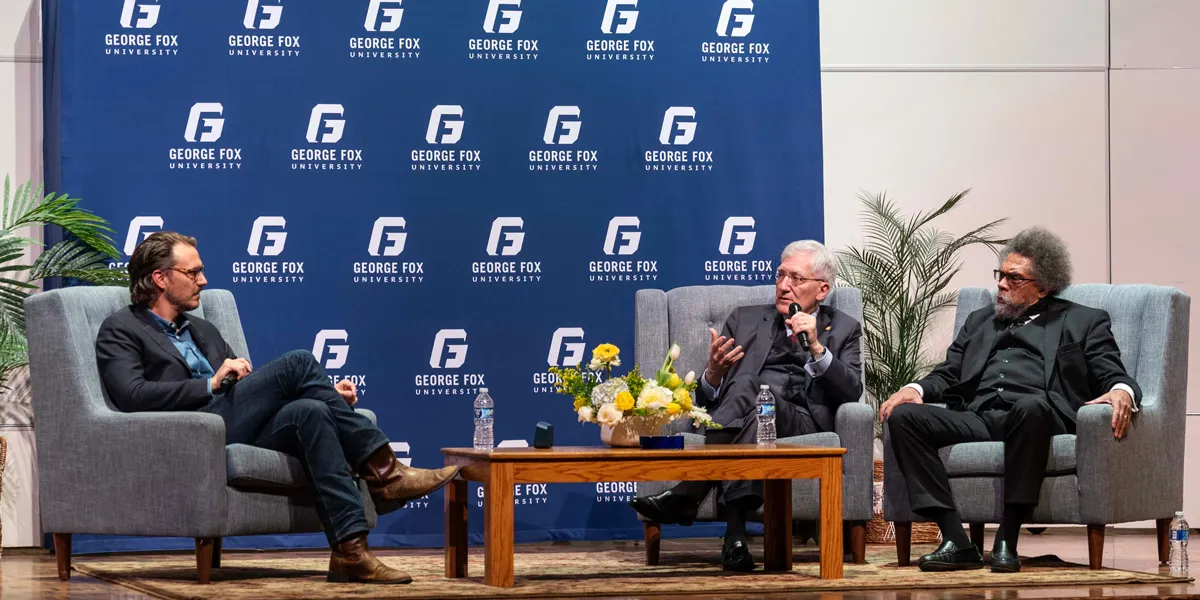
‘Civic Friendship in a Polarized Age’: A Celebration of Human Dignity
George Fox University guests Robert George and Cornel West remind us that our joint pursuit of truth, goodness and beauty form a bond far thicker than ideology or a party ever could
by Joseph Clair
I had the privilege of being mentored by Chuck Colson of Prison Fellowship during the final years of his life. At the time, I was finishing a master’s degree in philosophy in New York City and weighing PhD programs. Chuck urged me to aim high and to become a Christian thinker who would use my education for the kingdom. His first piece of advice: to learn something well, start by finding an exemplar.
He introduced me to his friend Robert George, professor of jurisprudence at Princeton – a conservative political philosopher, deeply committed to his faith, working at the highest levels of academia while making a practical impact on American life. I enrolled in Princeton's Religion, Ethics & Politics program.
There I also got to know Cornel West – a profound progressive political philosopher in the tradition of Martin Luther King Jr., equally committed to his faith and connecting scholarship to the practice of American life. I loved working with both of them, and I was struck by the tension: I deeply respected two men who stood at opposite ends of the political spectrum, left and right.
Then I discovered they taught a legendary seminar together on “The Good Life” – a first-year course with a long waitlist and a well-earned reputation. I thought it was admirable that they’d create a space where students could watch two very different thinkers wrestle honestly with big questions, modeling where they agree and where they don’t.
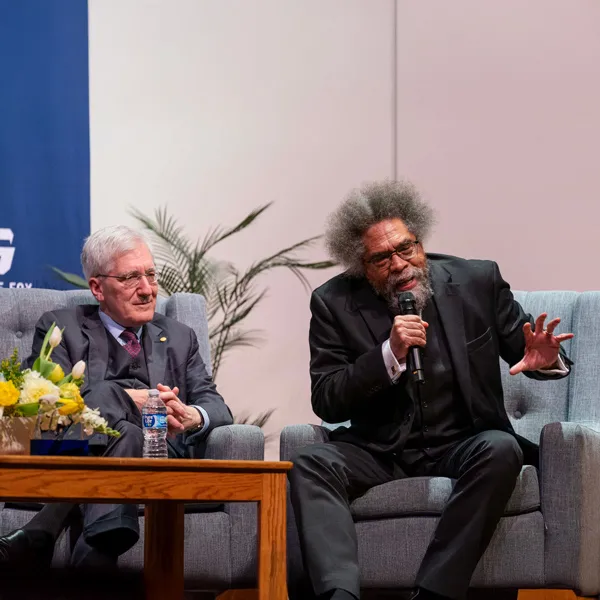
The Practice of Intellectual Humility
What I didn't fully appreciate until later was that the course was more than a lesson in charitable disagreement. It was a display of deep friendship – friendship made richer by the very human experience of loving someone with whom you fundamentally disagree, and choosing to stay in relationship anyway. Not doing so out of relativism – not a shrug of “your truth” or “to each his own” – but out of a shared commitment to objective truth. It’s a posture that says, “I know my grasp of the truth is partial and fallible. I need you to correct me. And I will do the same for you.” In that process, we don't just move closer to truth – we become more human, more loving.
Pope John Paul II made this commitment a hallmark of his ministry: “Do not accept anything as the truth if it lacks love. And do not accept anything as love which lacks truth. One without the other becomes a destructive lie.” At the heart of reality, the most fundamental attributes of God are truth and love – and they are inseparable.
Christian universities like George Fox are called to form students who hold truth and love together. So are democracies like ours, if we mean to keep the republic.
There is no better school for that than friendship.
Cultivating Civic Virtue for the Next Generation
Recently, that friendship was on full display at George Fox University, as we hosted professors George and West for “Civic Friendship in a Polarized Age” (available to watch below). What a joy it was to see Bauman Auditorium full that Thursday evening. As everyone there can attest, a conversation between West and George is something far more than dialogue or debate – it is a celebration of ideas, of friendship, of truth. A revelation.
I opened the evening by asking how they had remained such close friends across such sharp disagreement. West's answer came immediately: He paid tribute to three signs of Christian maturity he admired in Robert George – piety, integrity and humility. The honoring of one’s sources. The ability to say what you mean and mean what you say. The awareness of one’s own fallibility and dependence on others. These virtues, he noted, are increasingly rare in American life and desperately rare in academia.
When asked how we ought to remember America this summer – on the 250th anniversary of the Declaration – Professor George offered a stirring exhortation: be people of principle and example. Be good coaches, teachers, parents, grandparents, leaders at every level of our common life. Civic virtue must be passed from one generation to the next, or the republic will not survive.
It was a rare privilege to hear two public intellectuals range freely across big ideas while speaking with equal authenticity from the center of their Christian faith. However divided we may feel – as a nation, or even as a church – our guests reminded us that our common dignity as creatures made in the image of God, and our joint pursuit of truth, goodness and beauty form a bond far thicker than ideology or a party ever could.
Watch “Civic Friendship in a Polarized Age”


Related Posts

Human-Centered Design
Students in George Fox University’s Servant Engineering program design solutions that lead to a better life – one human at a time
‘A Win-Win’
Students and alumni create meaningful relationships through The Bridge Network and IGNITE mentoring programs
La Familia lo es Todo
Dahlia Citlalli Carrillo-Sanchez is driven to represent her family and culture at George Fox

Fox Fast Facts: Faith in Action at Fox
How does George Fox actively provide opportunities for service and connection with other Christians? Find out here!
‘Here is Water’
A professor and three students chose to answer God’s call, turning an engineering class into an impromptu baptism

‘Nothing was going to stop me’
There’s something that happens on your deathbed – a clarity about what’s important in life and the things you want to accomplish.