
Woolman Peacemaking Forum Invites Students to Explore Justice, Presence and Calling
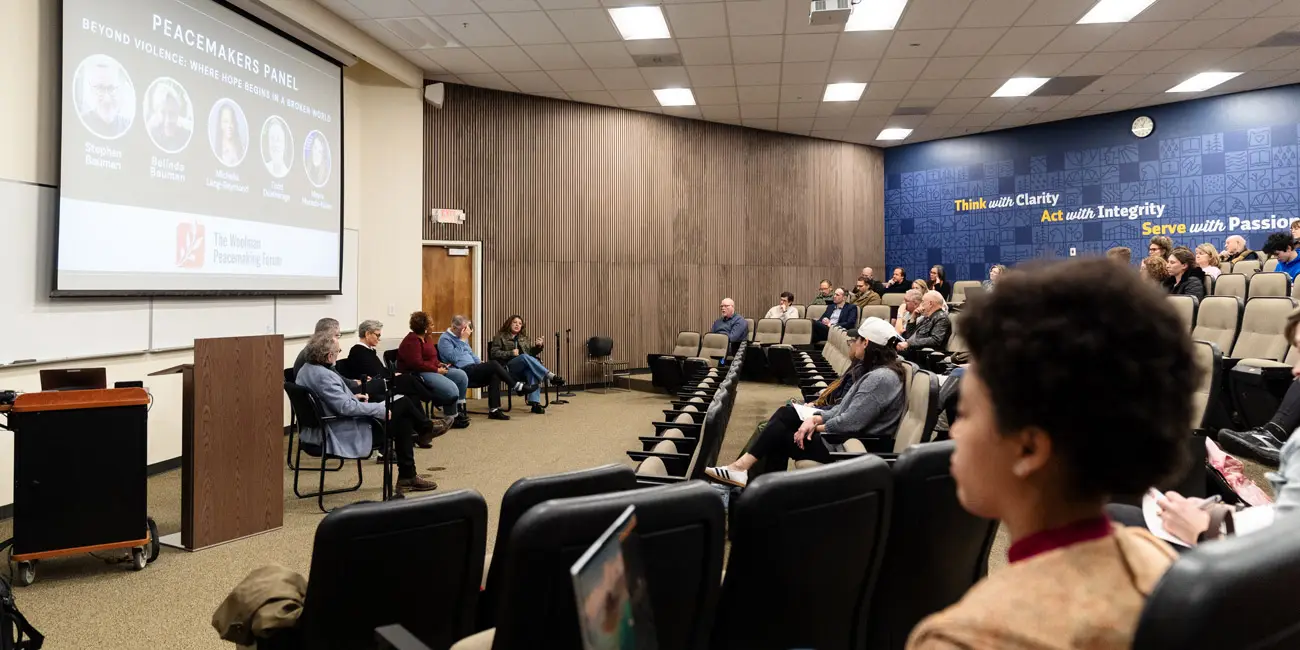
This year’s Woolman Peacemaking Forum at George Fox University gathered students, faculty and community leaders around a shared question: “How do we respond to injustice in a divided world?”
by Tamara Wytsma
Anchored in the theme from Isaiah 58 — “My justice will be a light to the nations” — the 2026 Woolman Peacemaking Forum invited participants to reflect deeply on justice, vocation and the role of faithful presence in a fractured world.
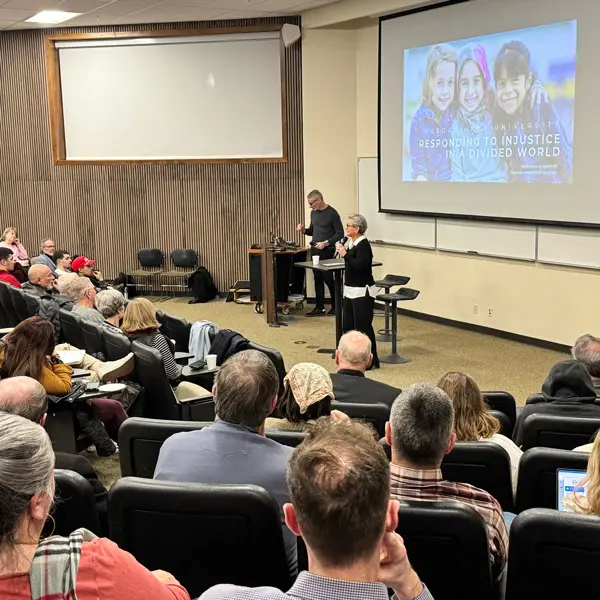
The keynote sessions were led by Stephan and Belinda Bauman, cofounders of Together International. Drawing from theology, neuroscience and their years of global humanitarian work, the Baumans explored how human responses to trauma and perceived threat often create the very conditions that lead to further injustice and division.
Yet the antidote, they suggested, is surprisingly simple: presence.
They described presence as:
Attention. Attunement. Availability.
Using insights from neuroscience and contemporary conflicts as case studies, the Baumans illustrated how fear can cause people to withdraw from those who seem different or threatening. The call of Isaiah 58, however, presents a different response. In the midst of human fear and injustice, God responds with a simple declaration: “Here am I.”
For many students, the keynote reframed what peacemaking might look like in daily life.
One student reflected on the challenge of practicing presence in ordinary moments:
“What would it look like to set my own [distractions] aside when I’m with someone, especially when someone is describing their own pain and troubles, and allow my attention to be focused, my empathy attuned to their suffering, and my authentic self be available to someone? Maybe it’s true that the incense God wants from me is to be radically present to those around me.” — Kiera H.
Another student noted that genuine presence may be one of the most meaningful ways to respond to injustice:
“Presence is the essential part of everything good, of every productive attempt of bettering this world. You have to be with people, wholly and genuinely. Helping others is sacrificial and loving, but it is best felt and received when you also offer your full presence … I think that is ultimately the best way for me to respond to injustice in this world: to offer my care, my time, my effort, and my understanding. Division can only be solved through connectedness.” — Addie D.
Learning From Practitioners of Peace
Earlier in the forum, more than 80 students and community members gathered for the Peacemakers Panel, which explored the theme “Beyond Violence: Where Hope Begins in a Broken World.”
Five panelists shared insights drawn from decades of work serving vulnerable communities both around the globe and here at home. Their experiences ranged from supporting communities in conflict zones to assisting victims of the L.A. fires, mentoring urban youth and walking alongside families grieving the loss of loved ones to violence.
Among the panelists was Todd Deatherage, cofounder of The Telos Group, who shared a powerful reflection from a bereaved mother who had chosen reconciliation over revenge to highlight the key work of peacemaking is disrupting violent systems of injustice and rehumanizing those who have been dehumanized: “To see the humanity in the other is the beginning of the end of conflict.”
Students returned repeatedly to this idea throughout the forum – the belief that recognizing the inherent dignity and worth of every person lies at the heart of justice and reconciliation.
One student reflected that the message reshaped how they understood both faith and peacemaking:
“I was struck by the statement that, ‘The idea that some lives matter less is the root of all that is wrong with the world.’ The forum left me with both a renewed hope in the coming of [God’s] kingdom and an increased passion for being present with my brothers and sisters, for learning to see all people as my own flesh and blood, and for esteeming and receiving others as Christ.” — Sophie E.
Another student echoed a similar conviction:
“Coming out of this talk, I feel called to see people as innately valuable and to live with this in mind, focusing on treating everyone I come into contact with as a child of God and remembering that our neighbor is everyone – even those who are completely foreign to us in belief, culture, lifestyle or appearance. I want to continue to grow in compassion and the willingness to offer my attention to others unselfishly.” — Jocelyn S.
Engaging the Arts in Peacemaking
This year’s forum extended beyond traditional lectures by incorporating the arts as a vital dimension of learning.
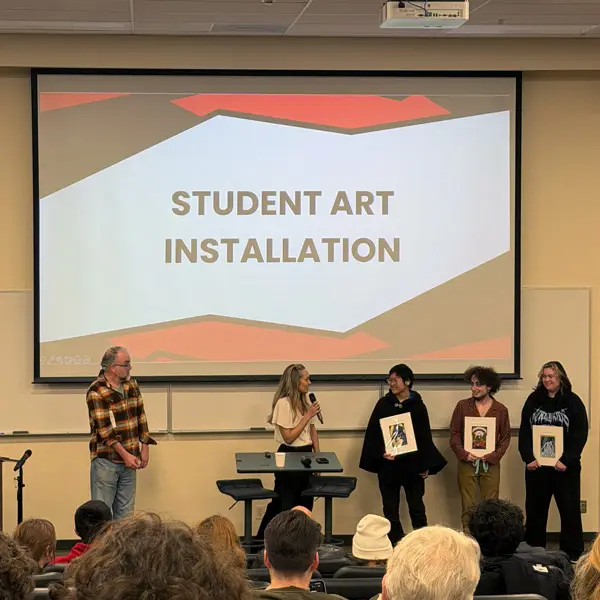
Professor Tim Timmerman and the School of Art & Design partnered with the forum to commission original student artwork inspired by scriptural themes of peace, justice and mercy. Each student artist was assigned a biblical passage and asked to interpret it visually, drawing inspiration from historic artists and typographic traditions.
The resulting collection transformed the halls of the Hoover Academic Building into a gallery of reflection. As visitors moved through the space, stopping at more than 17 booths hosted by nonprofit organizations serving marginalized communities. They encountered vivid artistic interpretations of biblical justice.
Panelist Michelle Lang-Raymond, founder of Acts on Stage and The Art of Tough Talks, spoke about the role creativity plays in shaping conversations around peace:
“As artists we are trying to mirror something that helps you take a journey to discover something that needs to be discovered within you.”
Vocation, Formation and the Call to Serve
Another key element of the forum was a student vocational discovery workshop that explored the relationship between calling, identity and service.
Rather than focusing solely on career outcomes, the workshop invited students to consider deeper questions: Who are you becoming? What values are shaping your life? What needs in the world are calling to you?
One student reflected on how the workshop reshaped their understanding of vocation:
“Calling is not just about career. It is about formation. It is about values. It is about what breaks your heart and what brings you deep joy …Calling is not a single moment of clarity; it is a lifestyle of attention. Paying attention to what moves us, what burdens us, and where our gifts can serve others.” — Bethany W.
A Hub for Conversation and Collaboration
While the forum centers on student learning, its reach extends well beyond campus.
On the eve of the forum, 22 leaders from philanthropy and justice organizations gathered for dinner, discussion and connection. These leaders – many of whom have dedicated their entire lives to humanitarian and advocacy work – came together to share experiences and insights with one another and to connect with the conversations on peace and justice that would continue throughout the forum.
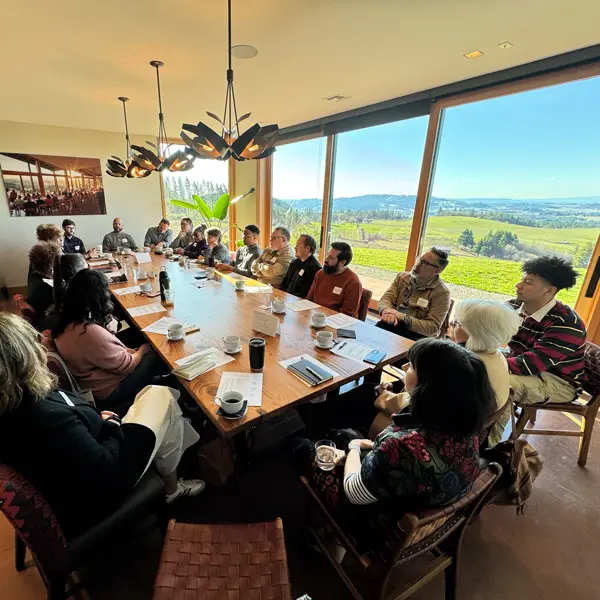
The following afternoon, 44 pastors and nonprofit leaders from across the region gathered for a seminar on the Principles and Practices of Peacemaking, exploring how peacemaking can be practiced in their congregations, organizations and neighborhoods. Around tables, leaders leaned into conversations not only about theory but about practice – how communities can be formed around justice, reconciliation and faithful service.
Following the public keynote events, the forum concluded with a half-day roundtable conversation among 22 thought leaders from multiple sectors who discussed the forces currently straining the bonds of society and the important role the rising generation of leaders will play in shaping a more just future.
Connecting Learning, Calling and Action
Throughout the week, the Woolman Peacemaking Forum created space for thoughtful dialogue about justice, hope, and the role of faith in addressing the world’s most pressing challenges.
For students, the experience connected classroom learning with real-world practice. Through keynote lectures, panel discussions, artistic engagement and vocational reflection, participants were invited to consider how their own gifts and calling might contribute to healing a broken world and lead them into a life of greater meaning and purpose.
In doing so, the forum embodied a central promise of the George Fox experience: helping students become people who are known, formed in character and equipped to bring their talents to the service of others.
And as the conversations throughout the forum made clear, peacemaking rarely begins with sweeping solutions. Often, it begins with something quieter – the willingness to be present, attentive and available to the people right in front of us.
Related Posts
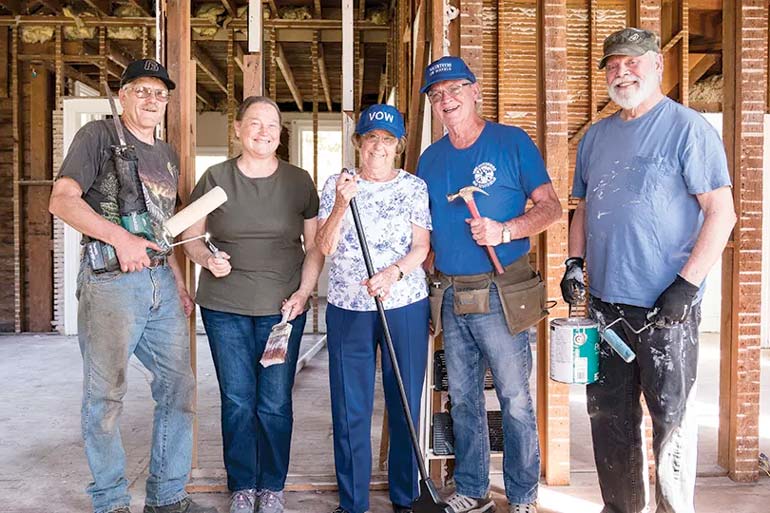
Volunteers on Wheels
A group of retired George Fox alumni travel the Northwest to help with church construction projects
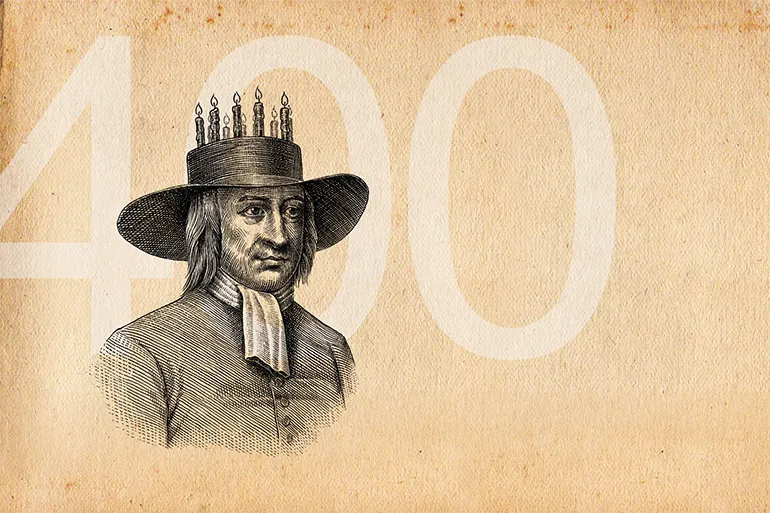
Happy 400th Birthday, George
He’s the founder of the Quaker movement, the namesake of our university, and in July, 2024 we’re celebrating the life and legacy of George Fox on what will be his 400th birthday.
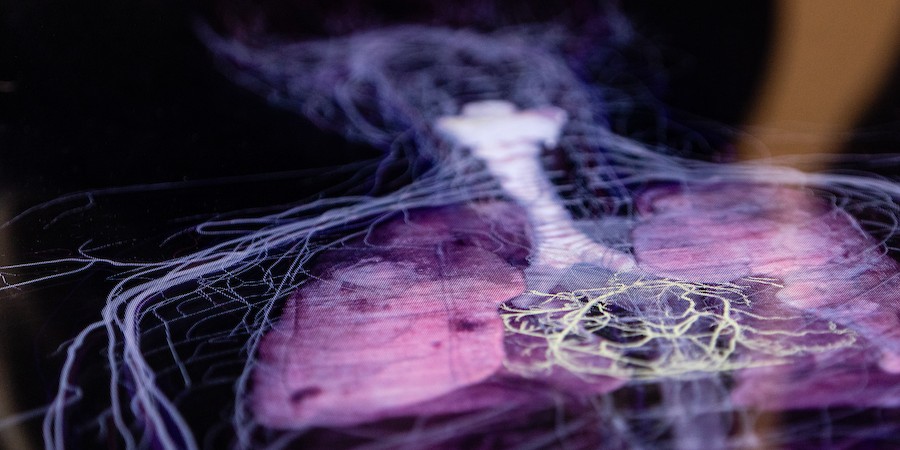
Biology Virtual Reality Lab
George Fox's science department opened a new virtual reality lab for biology and biochemistry students to gain hands-on experience.
Lasting Legacies
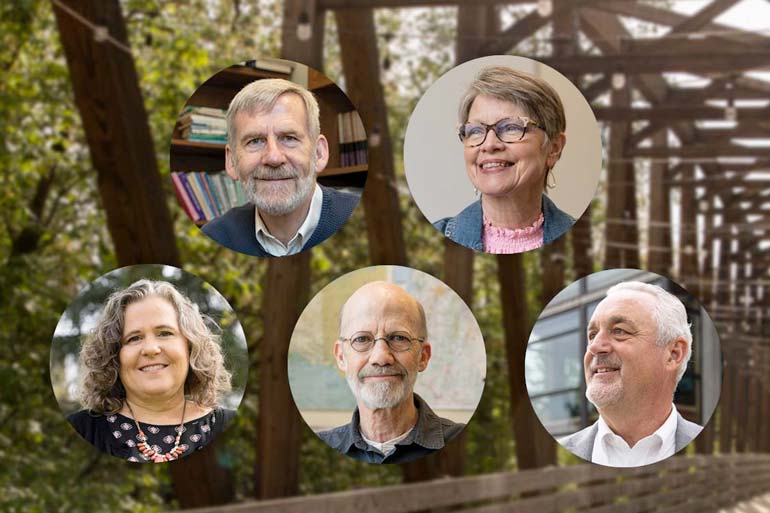
Five retiring employees reflect on what kept them at George Fox a combined 137 years
How George Fox University Got Its Name
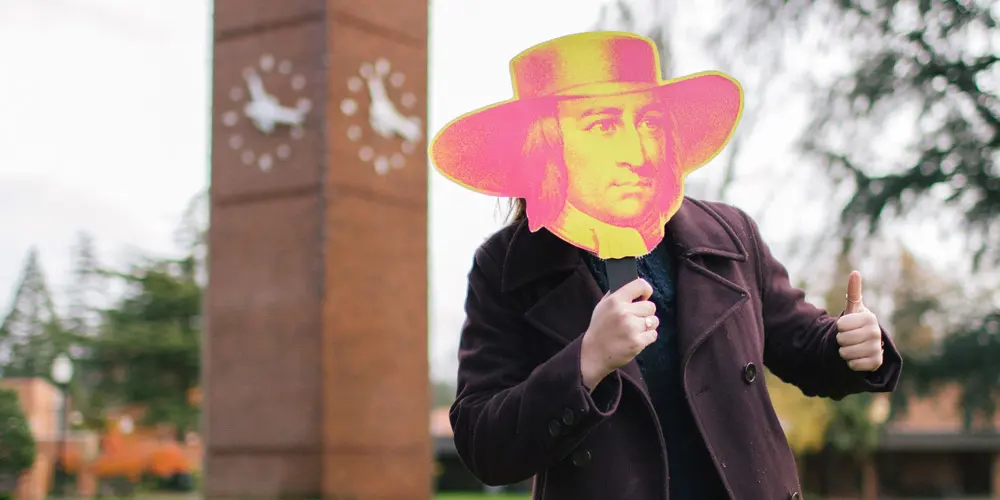
In the spring of 1949, the bold musings of young seminary student Arthur Roberts caught the attention of the college’s board, resulting in a name change to honor the institution’s Quaker roots
Undeclared to Unstoppable: Meet Daria Brandt
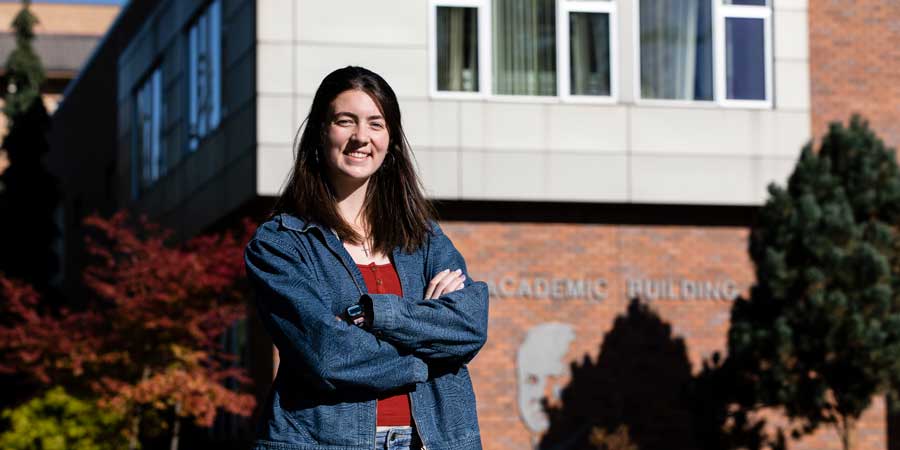
Having trouble choosing a major? That's OK, you don't have to have a declared major to go to college! George Fox even offers a class for those who haven't decided a major yet. Student Daria would go so far as to encourage people to come to college if they are undeclared; it's the perfect place to figure out what you want to study!