
When Personal Experience Becomes Professional Purpose
How a son’s heart surgery and a deepening professional curiosity led Dave Wilcox to George Fox’s new CRNA program
by Sean Patterson
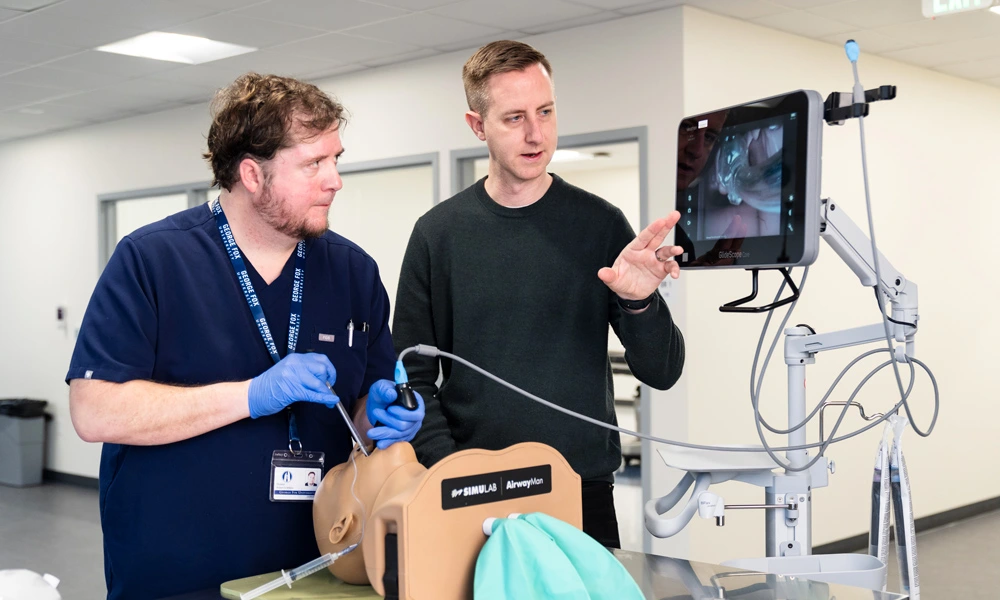
Dave Wilcox’s journey to George Fox University’s Certified Registered Nurse Anesthetist (CRNA) program did not begin in a classroom or a lab. It started in a hospital room.
One of Wilcox’s sons, August, was born with a congenital heart defect called an atrioventricular canal defect, a condition that eventually required open heart surgery in infancy.
“Walking through that experience, listening to the team explain his condition, handing him over for surgery, and seeing him come back calm and comfortable made a lasting impression on me,” says Wilcox, a member of the first CRNA cohort at George Fox. “Today he is doing well and continues to be a huge source of joy and perspective for our family.”
It was the first time Wilcox saw the power of anesthesia providers up close.
“I saw what it looked like when nurses and anesthesia providers combined expertise with genuine compassion, and it made me want to move toward that kind of work.”
An Early Interest in Medicine
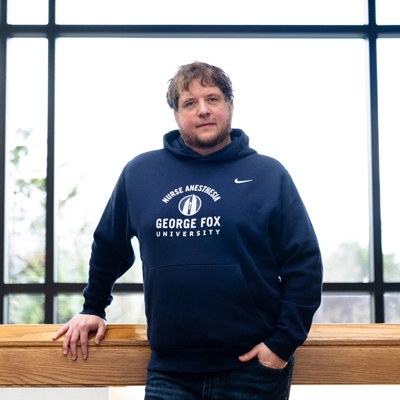
Years before, he had already developed an interest in the medical world. Growing up in Houston, he was one of five boys in a house where healthcare and entrepreneurship were part of the daily conversation. His mom was a labor and delivery nurse, and his dad was an entrepreneur in the medical supply industry.
“I grew up listening to stories about bedside care and building something from scratch,” he recalls. “That mix of service and initiative has stayed with me.”
That blend of curiosity and compassion inspired his decision to study biology at Texas State University, with a focus on wildlife and a minor in chemistry. Field research followed, taking him to Northern California and Southern Arizona. Later, he transitioned into the brewing industry, where he built a quality control program and learned to think in terms of systems, data, and reliability.
Discovering a Clear Direction
Today, life looks very different. He now lives in Portland with his spouse, their three boys, and their dog. Much of his time is split between coursework, everyday family adventures, and hiking and exploring the Pacific Northwest. “I am working to balance school, clinical preparation, and being a present dad and partner,” he says.
Before his son’s surgery, Wilcox was in science-based roles outside of healthcare. Walking through his son’s diagnosis and heart operation shifted his perspective and eventually his direction. He returned to school and completed an accelerated Master of Science in Nursing at the University of Arizona. Graduate study felt energizing. “I discovered that I enjoyed the intensity and pace,” he says.
After graduation, he accepted a position at a level one trauma center in Tucson, Arizona, with Banner Health, working in preoperative and post-anesthesia care. It was his first exposure to perioperative nursing. From there, he stepped into the cardiovascular intensive care unit, caring for patients just hours out of open-heart surgery. “It was rigorous, technical work that required managing invasive monitoring, ventilators, and vasoactive medications,” he says.
At the same time, he shadowed CRNAs in both team-based and independent practice models. That experience moved nurse anesthesia from an interest to a clear direction. “Seeing CRNAs manage cases across the lifespan, perform regional blocks, and practice with confidence and autonomy confirmed that this was the right direction,” he says.
The Challenge of Change
The decision to pursue a new career, however, was not easy. “I spent much of my twenties and early thirties trying to decide what I wanted to do long term,” he says. “Admitting that I wanted to leave a familiar career and start over in nursing was not easy, and there were moments when I wondered whether I was too late to make that change.”
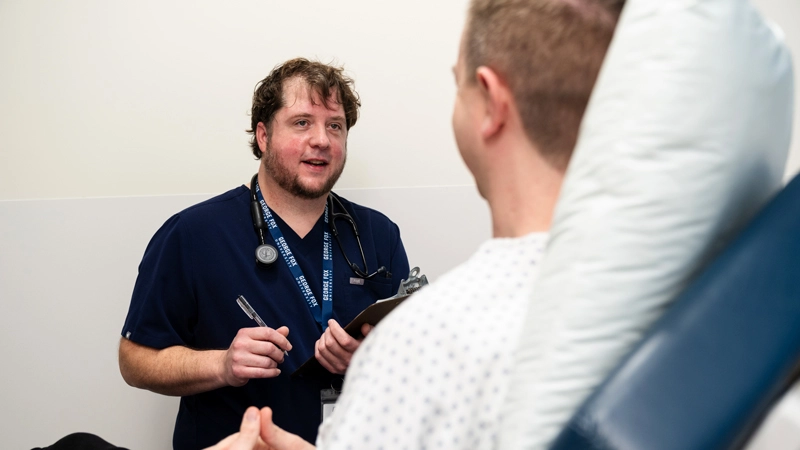
Returning to school with a young family during the COVID-19 pandemic added another layer of complexity. The accelerated program at the University of Arizona shifted almost entirely online, leaving him to create a home study space and navigate new modes of learning while balancing parenting and financial pressures. Each transition, from graduate nurse to perioperative nurse to ICU nurse, came with a steep learning curve, moments of doubt, and long days.
What got him through, he says, was “leaning on my spouse and our support system,” as well as building grounding habits like exercise, time outdoors, and staying connected to his community. Mentorship also played a pivotal role. “Seeking out mentors who were willing to give direct feedback made a significant difference and continues to shape how I approach the challenges of nurse anesthesia training.”
‘Complexity, Connection and Service’
He sums up his passion for the CRNA profession in three words: complexity, connection and service. “Nurse anesthesia brings together the parts of medicine that matter most to me: a deep understanding of physiology and pharmacology, precise technical work, and meaningful connection with patients and families,” he says.
He views each anesthetic plan as a carefully tailored, forward-thinking process, but it is the human element that inspires and motivates him.
“Having been a parent in the waiting room, I understand how vulnerable that position is,” he says.
“As a CRNA, you meet people on days when they are handing over control and trusting you completely. The opportunity to respond to that trust with preparation, humility, and a calm, honest presence is what draws me to this profession. In addition, the way CRNAs extend access to anesthesia care in rural and underserved communities fits with my values around equity and service.”
Looking Ahead
His future goals reflect that same blend of technical ambition and relational care. Clinically, he hopes to work in cardiac, thoracic, or other complex surgical environments. He also wants to contribute to safety and quality initiatives and eventually teach and precept future nurses and nurse anesthesia residents.
On the personal side, he hopes to stay connected with communities that support families navigating serious pediatric illness and complex heart disease, and to make sure life continues to have space for “being outdoors, cheering on my kids, and staying connected to the curiosity about the natural world.”
George Fox: ‘The Right Fit’
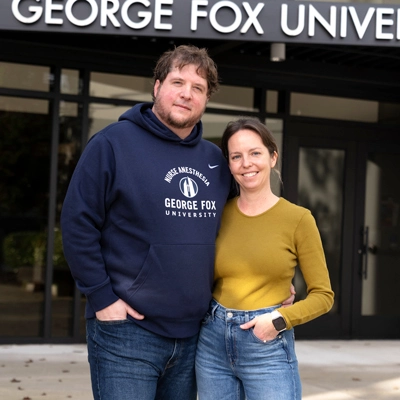
As for why he chose George Fox for his CRNA education, he points to its sense of community, the mentorship offered, and the university’s mission, which includes a commitment to “serve with passion.”
“I was looking for a program that would challenge me academically and clinically while also caring about who I am becoming as a person and professional,” he says. The smaller cohort size and emphasis on whole-person development felt like the right fit.
He also appreciated the opportunity to join a new program. “I liked the idea of being part of a cohort that could help shape the program’s culture and traditions rather than simply fitting into a long-established mold. What I appreciate most about George Fox is the balance between high standards and genuine support.”
For him, this balance ensures he is not only learning anesthesia but learning how to think, respond, lead and grow.
“The coursework is demanding, simulations are realistic, and expectations are clear, but the faculty remain approachable and invested in our growth,” he says. “They are willing to share their own experiences, give honest feedback, and create space to ask questions without feeling judged. My classmates come from diverse backgrounds, and there is a strong sense that we are working together rather than against one another.”
Above all, he carries a deep sense of gratitude. “It took me time to figure it out,” he says. “Once I stepped into nursing and now pursuing nurse anesthesia, it feels like the pieces have finally lined up.”
His goal, now and in the future, is simple.
“I want to become the kind of CRNA I would want to care for my own child, and everything I am doing at George Fox is aimed at growing into that kind of provider.”

Related Posts
A Holistic Approach to Nursing Education
Pam Fifer, dean of the College of Nursing, is living out her lifelong dream of leading a George Fox nursing program that considers all aspects of a patient’s condition – be it physical, psychosocial or spiritual.
‘Open and Willing for Whatever God Has for Us’
Portland Seminary student Joff Williams serves as senior director for spiritual formation with the Mercy Ships organization as he pursues his doctorate
George Fox University Launches CRNA Program to Strengthen Rural Healthcare
In many rural communities, patients face delayed or canceled surgeries due to a lack of anesthesia providers. To meet this critical need, George Fox University is launching a CRNA program in fall 2025.
Navy Corpsman Overcomes Hurdles to Chase CRNA Dream
After weathering academic hardships, a chronic illness and personal doubt, veteran Wayne Dorman finds himself in George Fox University’s Doctor of Nursing Practice program
Certified Registered Nurse Anesthetist Faculty Spotlight: Bill Prosser
Recently Bill opened up about how he discovered nurse anesthesia, how cancer provided clarity about his career choice, what inspires him about his new role, and his vision for the George Fox CRNA program.
Paying Kindness Forward
As a child, Jordyn Grabenhorst accompanied her little brother to his occupational therapy sessions; now she’s pursuing a career in pediatric occupational therapy.