
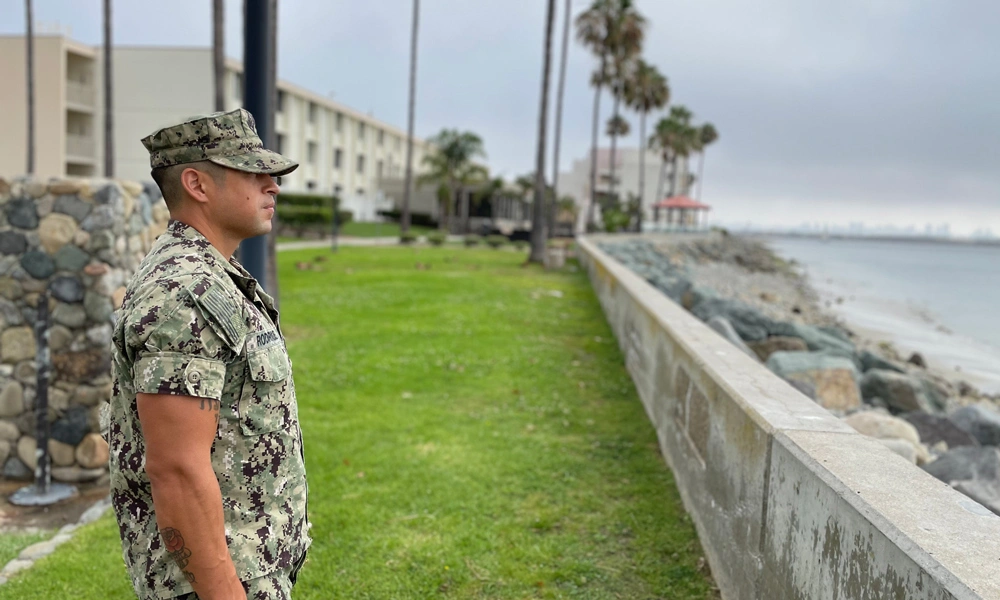
Navy Veteran Comes out of Retirement to Fill Education Gap
Accelerated Teaching Degree grad Daniel Rodriguez saw the fallout in education post-COVID and decided to step up to the challenge
by Audrey Grice
When Daniel Rodriguez retired from a 21-year career in the United States Navy, his plan was to live his best retired life and maybe help out at the office of his wife’s physical therapy practice. But then he saw the teacher shortages in K-12 education.
“It was the year schools in Oregon went back to in-person after COVID, and there were a lot of staff shortages,” Rodriguez says. “I was just going to stay retired, but I saw schools needed help, and I thought, ‘I could do more. I could serve.’”
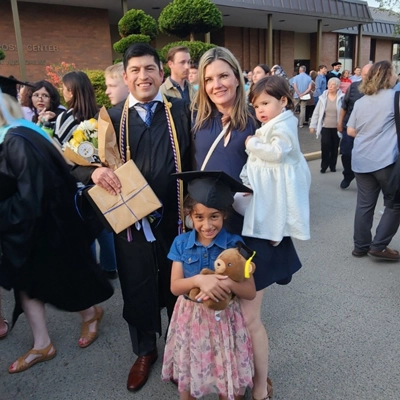
Having joined the U.S. Navy out of high school, Rodriguez needed to go back to school and get a bachelor’s degree to start teaching.
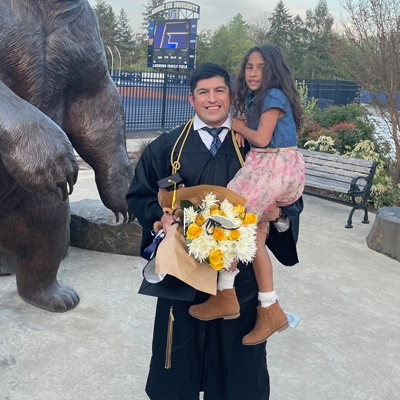
Using the GI post-9/11 Bill, he graduated with a bachelor’s degree from George Fox through the Accelerated Online Teaching Degree program in April of 2024. In August of the same year, he started as a seventh-grade physical education teacher in the same school district he graduated from. Now, he teaches seventh- and eighth-grade social studies.
“I have the opportunity to do something a lot of people don’t, which is go to school and have it paid for,” Rodriguez says. “And now I get to use that to make a difference in people’s lives.”
An initial challenge was the online aspect of the degree, as part of the GI Bill stipulates the student has to be in-person to receive maximum benefits. The solution: Rodriguez attended the virtual class with his professor.
“A Fox professor would show up with just the two of us in a classroom, and everyone else would be on Zoom,” Rodriguez recalls. “I really appreciate George Fox for doing that and the staff for making that accommodation so I could receive the full benefit from Veteran Affairs.”
Rodriguez values the support he received as a veteran at George Fox.
“The Veteran Affairs team did a really good job,” he says. “They gave me all the explanations I needed on how to use it. They were always there for me when I had questions or something came up on how the GI Bill applied, and that was really important.”
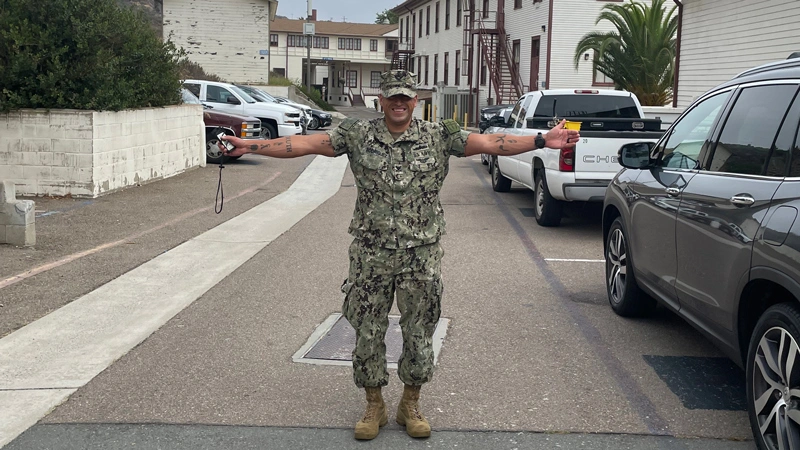
Navigating a New Career
While moving from the navy to the classroom was a transition, Rodriguez found his military experience provided a unique perspective for teaching middle school.
“I teach social studies,” he says. “For many countries I’m teaching about, I’ve been there, served there, worked with people that are there, or looked at them as an adversary. Even though we may have looked at them as a potential adversary, we still learn a lot about the people, culture, history, and maybe why things became that way. History has a lot of conflict, but it gives me an opportunity to talk about problems we face, not just internally ourselves, but as people.”
As he teaches these topics, Rodriguez values students’ perspectives. He encourages disagreements and stresses respectful behavior when engaging in discussions.
“We do look at opposing arguments,” Rodriguez says. “Man, I’m glad I have a classroom where we can do that and students feel safe to share their thoughts and opinions.”
One way Rodriguez is fostering a positive learning environment is by having students participate in a Socratic seminar, an idea he picked up while at George Fox. He was blown away by the results.
“I listened to the seminars, and I would have thought I was in a master’s program,” Rodriguez says. “Seeing some of the ideas and thoughts students were sharing and how respectful they were of one another was incredible.”
Rodriguez is proud of his students’ abilities to tackle tough subjects with viewpoint diversity. He teaches early U.S. history, which means learning about issues such as the country’s tumultuous past with exclusionary laws, indigenous peoples, and systemic racism.
“I’ve seen more acceptance of other people’s views and opinions and willingness to acknowledge them and see where they’re coming from,” Rodriguez says. “Even if they disagree, they do it in a civil manner. It can happen within the school walls. And if it can happen here, I have to believe that it can happen when they’re adults too.”
Fostering a Learning Environment
Even with this incredible display of empathy and respect from his students, Rodriguez is honest about the struggle of teaching middle schoolers.
“There’s a lot of emotions and things happening, and they manifest themselves in middle school ways,” he says. “That can be challenging at times.”
After over two decades in active military service, however, “challenging” is not a negative word for him – it’s a call to action.
“I stay in teaching because I know I can,” Rodriguez says. “Just like when I was in the service, it was challenging, and I did the job because I knew I could. Most intel people worked in windowless, air-conditioned buildings. I went with the units that were going to be outside in adverse conditions. Combat engineers, explosive ordnance disposal, special operations—I was here for it.”
The difficulties that come with teaching middle school aren’t why Rodriguez shows up to work every day. What brings him back is the ability to create a positive environment and seeing students coming into the classroom excited to learn.
“Any student who walks through my door needs to feel safe and happy, and that they want to be here, most importantly,” he says. “I have to meet the foundational needs. If students feel safe and happy and their needs are met, then they’ll want to come back and want to learn.”
Learning how to meet students’ needs and keep them engaged in the classroom are skills Rodriguez was exposed to at George Fox.
“George Fox did a good job of giving me strategies to engage students, meet them where they’re at, and give them grace,” Rodriguez says. “There are things we can do to get past the technology barrier and also recognize where they’re at without disengaging them. If a student shuts down, they’re probably not going to learn.”
Rodriguez’s work as a middle school teacher is a testament to a life characterized by service, first to his country and now to his classroom.
“I didn’t plan on teaching,” Rodriguez says. “I started because it’s just in me to serve. Service is a big part of who I am.”
Related Posts
Serving ‘One Child at a Time’
Alumna Glenda Quezada launches a Spanish immersion preschool, hoping to change lives both at home and abroad
‘I’m Looking Out for Them’
Educator Jason Murray is modeling the same mentorship he received as a child
Fox Fast Facts: Accelerated Online Degrees
Get your degree from a nationally recognized university. Be an asset at work and an example to your family. Learn more about our Accelerated Online Degrees, designed for working adults.
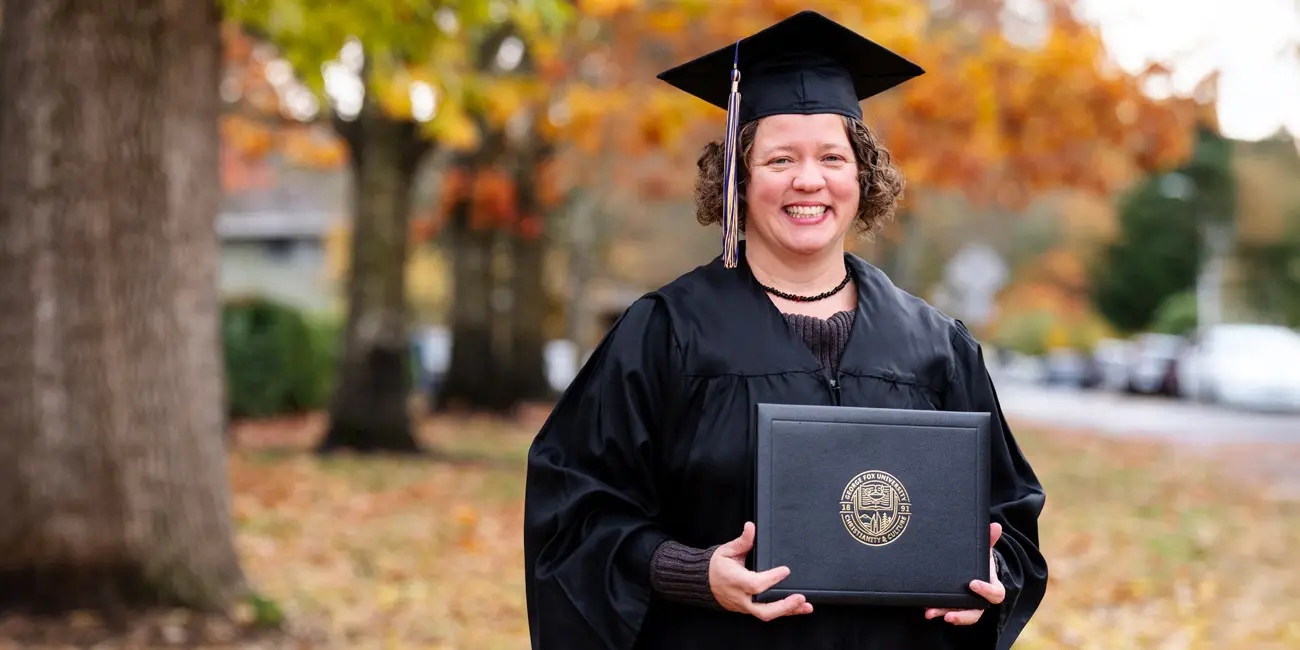
Alumna Uses Experience and Education To Advocate for Domestic Violence Survivors
Psychology and mental health studies graduate Lisa Jones uses her voice and her degree to speak up for those who suffer in silence
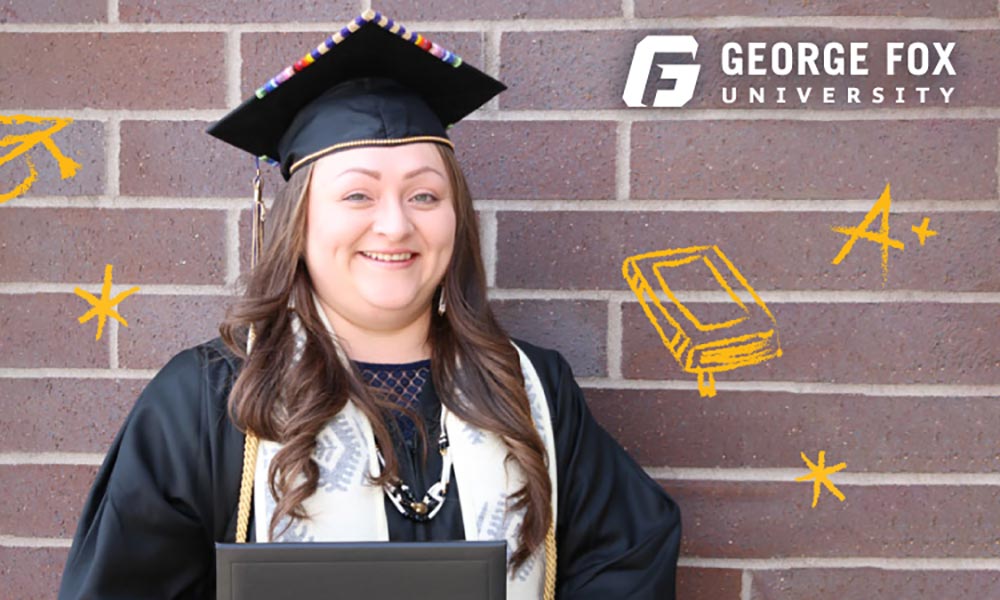
'I Promise I'll Be Back'
By earning her bachelor’s in the elementary education degree completion program at George Fox University, Kayla Kneeland stays invested in her community on the Warm Springs Reservation, where she was born and raised.

From High School Dropout to Straight-A College Grad
After battling for a comeback, Rachael White gives back to the community that supported her in the Adult Degree Program.