
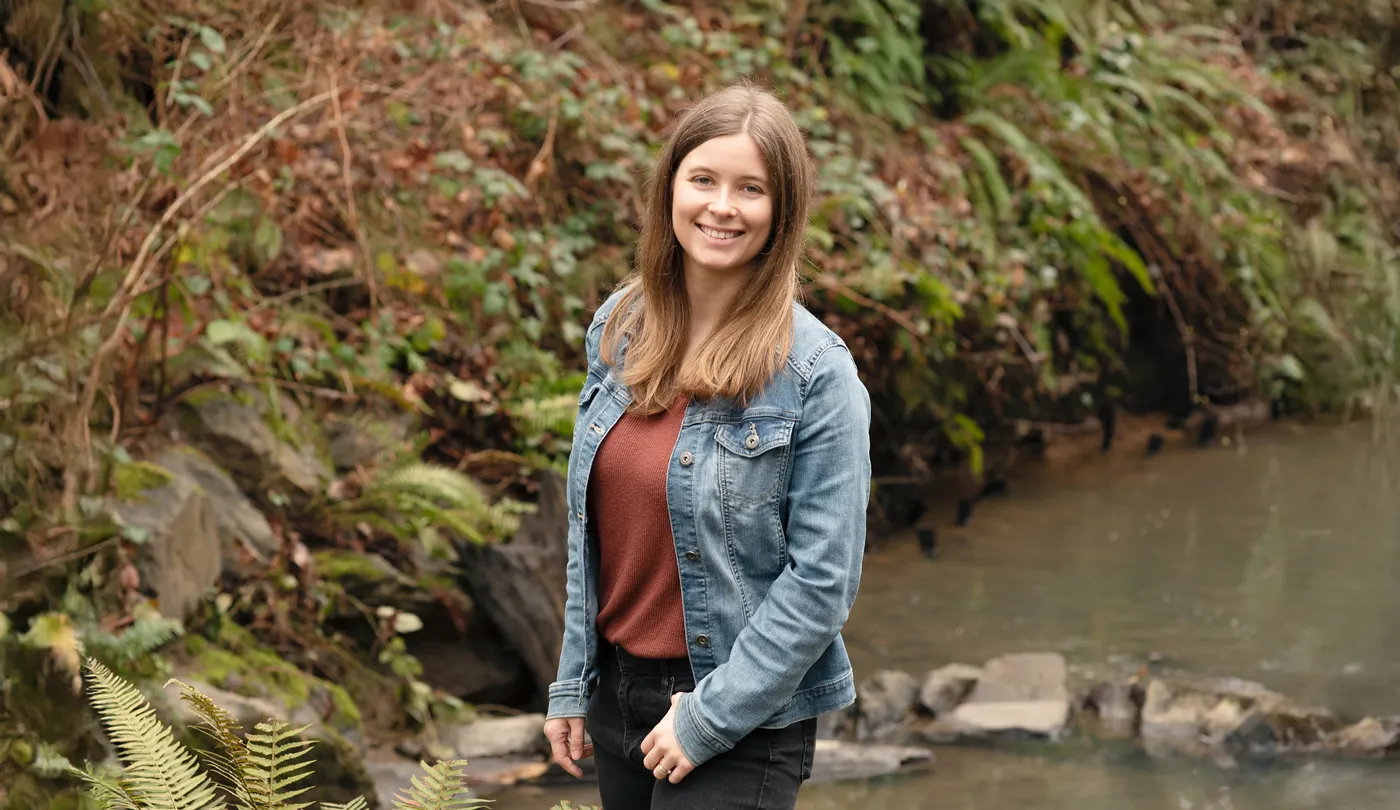
OT Student Cultivates Independence in Her Clients
Elizabeth Schroeder’s appreciation for mobility serves as motivation to pursue a career helping others
by Sophie Roberts
Growing up, Elizabeth Schroeder was chronically in motion. She played sports with friends, "did figure skating for a hot minute," and saw every tree as an opportunity to climb as high as possible.
It wasn’t until years later, while playing “patient” in the arms of another occupational therapy student, that she recognized why movement was so important to her. “It’s a very vulnerable position to be in, putting a lot of trust in the person helping you,” she says. “It’s really hard and scary for people.”
A Heart for Service
Schroeder has always been drawn to serving people in need. “It’s what I saw a lot of growing up in my family,” she says. “It’s a value that my parents instilled in me.”
When she took a psychology class in high school, Schroeder was convinced she would become a therapist, but shortly after starting in the undergraduate psychology program at George Fox University, she noticed accessibility gaps in the community and added a major in social work.
“A big part of George Fox is our mission to serve people,” says Schroeder, now a student in George Fox University’s occupational therapy doctorate (OTD) program. “I think it’s something that I saw a lot growing up with my faith background, helping people who didn't have opportunities as much.”
George Fox’s annual Serve Day, when the institution closes to allow students and faculty to serve alongside one another, resonated with her, as did the university’s service-oriented James Project initiative. “We went out to people’s homes to serve them and help meet their basic needs,” she recalls. “There was an emphasis on social justice and making sure we’re looking beyond just the psychology side of things.”
Discovering OT
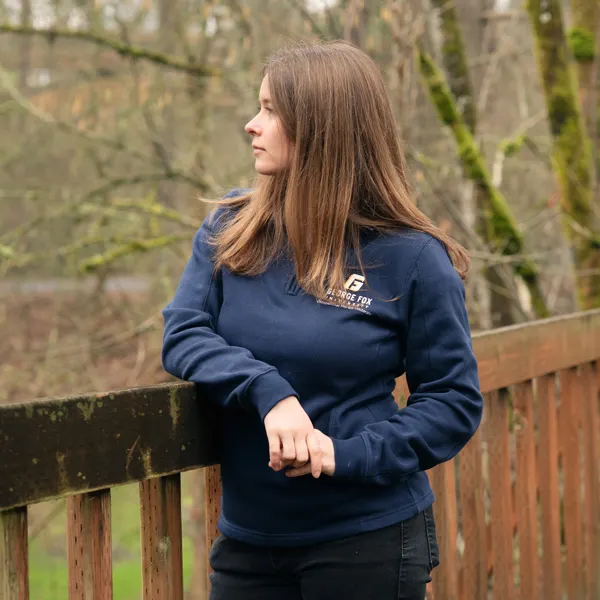
After graduating in 2016, Schroeder worked in a community-based mental health setting, assisting children with behavioral and sensory challenges. While on the job, she developed a fascination with occupational therapists’ holistic approach to health.
One instance in particular showed Schroeder how occupational therapy could help a family understand their child’s behavior. A parent came in, saying that their child was rebellious – they didn’t want to put on their socks, struggled with showers, and had difficulty with food.
But as Schroeder worked with a team of occupational therapists, they uncovered that the behavioral challenges were actually signaling sensory struggles – not rebellion.
“Once I started to educate the parent on what was actually going on in their kid’s body, it was like a light bulb clicked,” Schroeder recalls. “It wasn't a matter of, ‘You’re being obstinate because you’re trying to be obnoxious’ or something. There were actually challenges they could tackle and overcome – something they could work on together.”
With time and the application of an occupational therapist’s advice, the parent-child relationship mended itself. “And I was like, ‘I want to be able to do that part of it. I feel like I’m doing a piece of it, but I’m seeing this missing, physical piece that I want to know more about.’”
The Obstacle
Curious about occupational therapy, Schroeder applied to Pacific University’s OT program in 2019 – then the only OT program close to home. She was waitlisted, just before COVID-19 struck. “I’m grateful I didn't get accepted,” she says. “It was one of those things where it was meant to be.”
Instead, she worked at a school in Forest Grove, helping students develop their fine-motor skills for writing. When an occupational therapist came to the school and hosted a talk about fidgets in the classroom, Schroeder was reminded of why she wanted to pursue OT.
She was talking about how they can be used to help regulate all the internal systems of your body, and how those are needed to help kids focus and engage in class. And I was like, ‘Oh – this is what got me interested in OT in the first place!’”
A Return to George Fox
Schroeder continued working in Forest Grove until her father, a faculty member at Portland Seminary, discovered that George Fox was launching an occupational therapy program. Schroeder was quick to enroll.
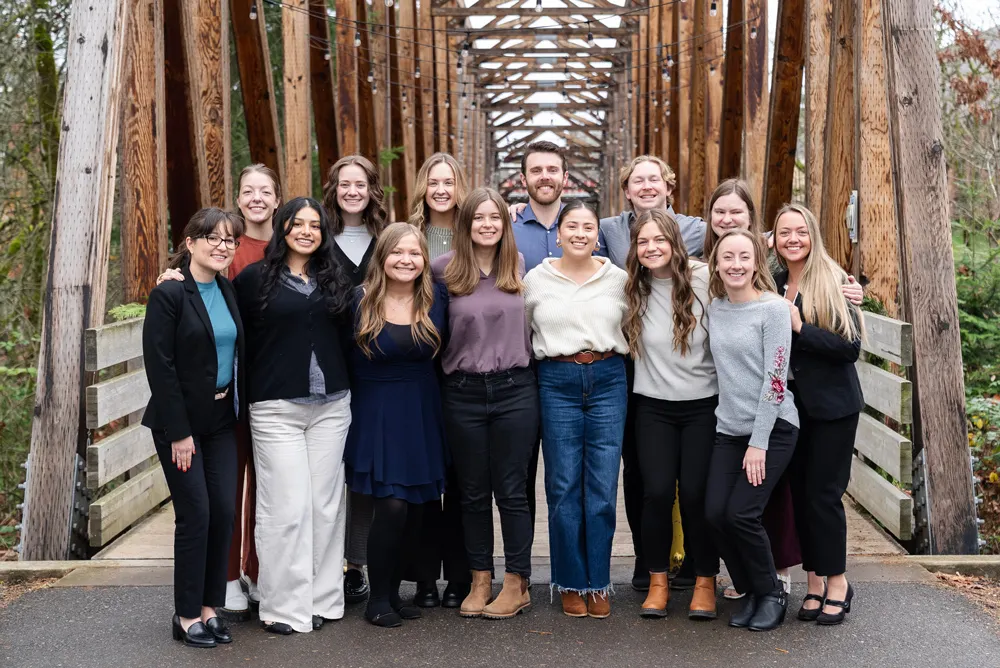
On her first day back on campus, only 13 other students were in the classroom. “We got to know each other very well,” Schroeder says with a smile. “It was the same people, every class, every day.”
Those close relationships with peers and professors further affirmed her decision to return to Newberg. “I know it’s cheesy because it’s such a George Fox thing, but I do think that the Be Known promise, especially being in the first OT cohort, is special.”
When Schroeder was going through a difficult season the summer after her first term, she opened up with Kate Turner, the program's director and one of her professors. “Within a very short period of time, a lot of personal stuff went awry in my life, so I went to Kate and poured out all of it. She was super supportive.”
The next day in class, Turner had left an encouraging card on Schroeder’s desk. When the professor tells her students that she’s always there for them, Schroeder knows she means it.
“I really feel like I can go to my professors with anything. I’m not just a number or some random student – I could approach them at any point in time and chat with them about school or my life or my interests, and they really know who I am and care about giving me the best opportunities.”
An Interest in Assistive Technology
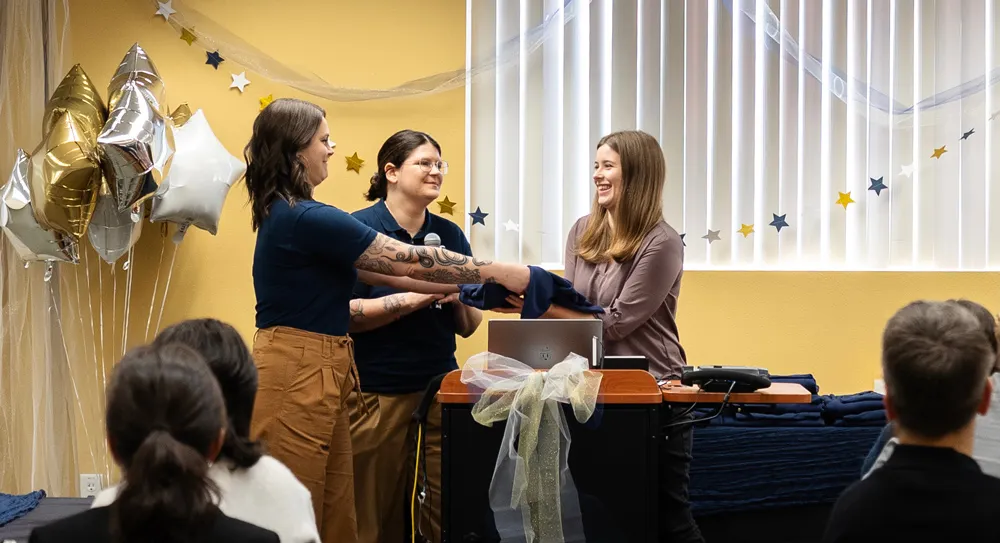
What recently resonated with Schroeder was the chance to take an assistive technology class with Professor Micki Kleven. The course covered wheelchair seating and mobility, practicing patient transfers and additional care in an on-campus simulated apartment.
The cohort split into pairs, with one student playing the patient and the other the occupational therapist. “We would move each other around and stuff. We’d also have practical exams where we would transport a professor!”
And while the goal of the exercise was to teach students how to help their patients, it also gave Schroeder a glimpse into the patient’s perspective. “It brings awareness to how you want somebody to approach you in a situation so that you feel safe and comfortable,” she says. “Like, I can use my legs if I find myself in a situation where a transfer went south – but if I couldn’t? It's a very vulnerable situation.”
As Schroeder played patient, she felt for those she hopes to serve in the future. “As a therapist, I want to make sure I’m building that rapport with people so that they feel comfortable with me helping them.”
Schroeder would love to help people with physical mobility needs in the future, assisting with equipment like wheelchairs. “It's allowing people to have the freedom to engage in their lives,” she says.
One of the reasons Schroeder finds herself so passionate about mobility is because she’s seen how losing mobility robs a person of freedom. “I’ve seen how loss of mobility affected one of my close friends – but I’ve also seen how she’s gained more freedom and autonomy since getting mobility devices.”
Future Goals
Schroeder is also considering becoming a certified hand therapist, and is excited to learn more about it in her field work in 2026. “It’s really interesting – I mean, think about the things you do with your hands in a day: getting around, typing on the computer, taking a drink of water.”
Schroeder adds climbing at George Fox’s rock wall to her personal list because, as it turns out, her love of climbing never disappeared. “My brother got into rock climbing a couple years ago, and was like, ‘You should come with me,’ and I did. I was like, ‘This is the best!’”
As Schroeder scales walls, she looks forward to the day she can help others feel the same freedom to move. “I would love to be helping people with physical mobility stuff, like wheelchairs or things like that, just to have more access to their homes or public spaces,” she says. “If you can’t get somewhere, it’s really hard to go out and be a part of the world around you.”
Related Posts
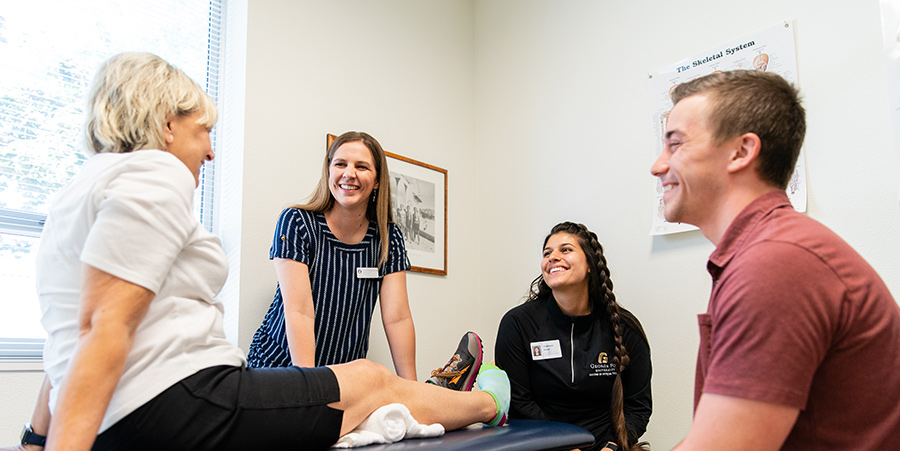
‘We Work Better Together’: Interprofessional Education at George Fox
George Fox grows innovative leaders through interprofessional education in holistic healthcare.
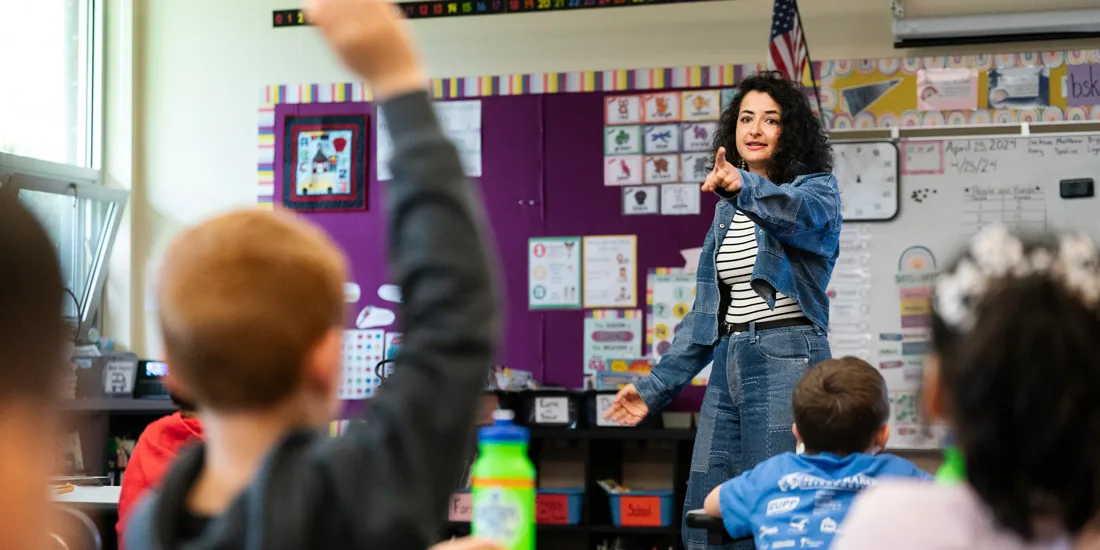
Resilience Personified
Forced to leave her homeland as a teen – and faced with the sudden deaths of family members – Mirna Pani models for her school counseling students what it takes to overcome hardship
Lending a Helping Hand
Occupational therapy student Laurel Anderson is passionate about finding creative ways to help people achieve their everyday goals.
A Voice for the Voiceless
Once afraid to speak up, MBA graduate Nathalie Angulo now leads teams at Salem Health to ensure others are never silenced
Encouraging Resilience
Occupational therapist Kate Turner returns to the classroom to help George Fox OT students advance their hands-on learning.
Army Officer Discovers the Healing Power of a Listening Heart
Occupational therapy student Makayla Clark transforms her natural compassion into a clinical advantage as she prepares to help veterans and other patients live to their greatest capacity