
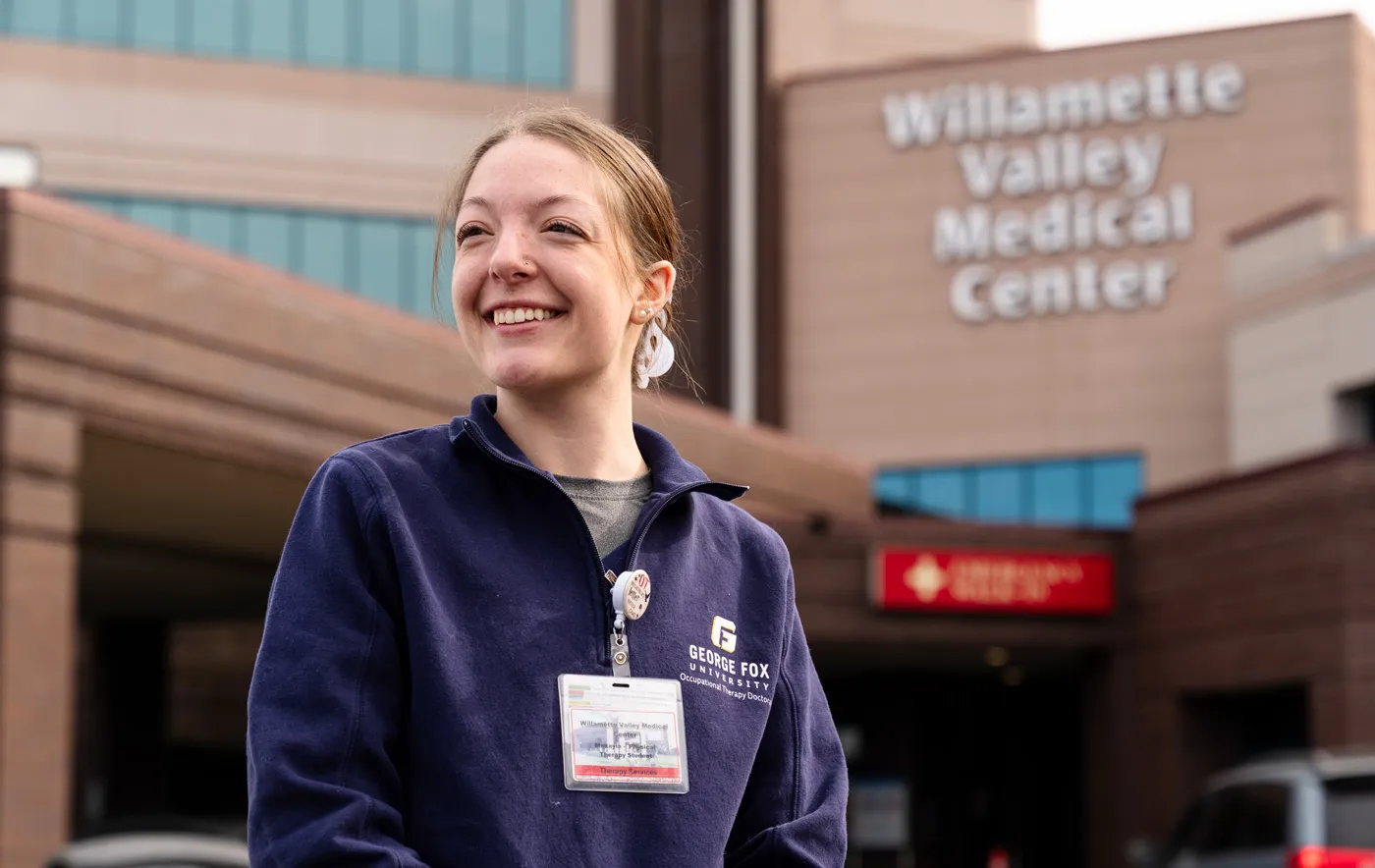
Army Officer Discovers the Healing Power of a Listening Heart
Occupational therapy student Makayla Clark transforms her natural compassion into a clinical advantage as she prepares to help veterans and other patients live to their greatest capacity
by Sophie Roberts
He knew Clark was empathetic, had a listening heart, and had a knack for understanding people. But unlike some members in her ROTC squad, he knew that those weren’t weaknesses – they were strengths she could leverage to help others feel known.
When he said it, Clark finally felt free. She was one of the few women in her group, with an unconventional leadership style that clashed with expectations. She was misunderstood, disrespected for being “too feminine,” and then for being too direct when she had to be.
But after following her Lieutenant Colonel’s advice – and studying at George Fox University to become an occupational therapist – Clark is unafraid to lead with a listening heart.
Seeds Planted
Clark grew up in a small military town in Idaho and remembers visiting a physical therapist in high school to evaluate her sports injuries. Something about the work – about helping people regain their independence – resonated with her.
“I knew in high school that I wanted to do something in the realm of therapy or medical sciences,” Clark recalls. “I went to physical therapy, and I was like, ‘Oh, this is kind of what I’m interested in. But there’s something missing.’”
Clark was still unsure what she wanted to do, and while attending a career fair with her friend, she followed her to a Marine recruiter’s booth. She found herself in a conversation with the recruiter about how her values aligned with the Marines’.
“I don’t have a defining moment when I decided to join the military, but my best friend talked me into meeting with an Idaho Army National Guard recruiter after that. The recruiter asked me how I would want my future to look inside and outside the military, and we had a long conversation about some obvious biases with officers – and in some cases, against females in leadership roles.”
But Clark was far from dissuaded. After meeting with the recruiter, she decided it would be in her best interest to join a branch that would allow her to attend school while gaining experience in a lower-enlisted role before being commissioned.
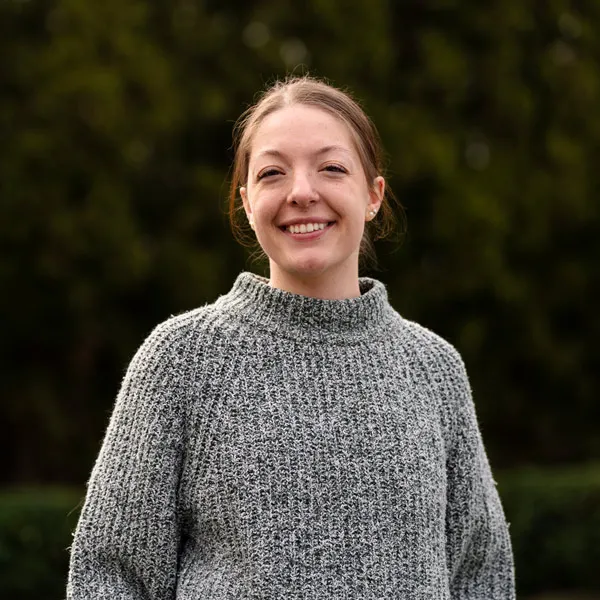
After her graduation in 2019, Clark’s enlistment in the Idaho Army National Guard almost immediately overlapped with the pandemic. She spent her gap year at a training base in Georgia, where officials were tested for COVID every morning upon arrival. There was no true mask mandate on base, and it felt like a little bubble, tucked away from the outside world.
When Clark returned to Idaho to start her undergraduate degree while in the ROTC program, she struggled with the culture shock. While most students in her new classes had spent their senior years taking courses on Blackboard, Canvas, and Zoom, Clark had been living without masks and with in-person interaction.
“Going to the second-largest college in Idaho, I was like, ‘Oh, this is serious, and I don’t know how to work anything.’”
‘That’s What I Want’
During her first semester of college, the university hosted an occupational therapist who shared how a patient with Parkinson’s disease regained independence with the help of an OT. As Clark listened, something clicked.
“I was like, ‘That’s what I want.’ Most of the time, people think, ‘Once a disease hits or something bad happens to someone, then they’re kinda done.’ And I was like, ‘That's not true! I want that extra hope, pushing to create independence for someone.’”
What really stuck out to Clark wasn’t just the challenge of occupational therapy, but the way it kept patients at the center of everything. “I feel like if you look at other disciplines like nursing or physical therapy, PAs or doctors, a lot of it is research-based, medical-based. And while OT has to rely on research as well, there’s more exploring and fun, in a way.”
Sound Advice
During her freshman year in ROTC, Clark had been trying to lead more conventionally. “But my Lieutenant Colonel told me, ‘This isn’t you. Don’t do something that’s not you. Use your empathetic side. Be the occupational therapist and officer that people can talk to.’”
For Clark, it felt like a burden had been lifted. She didn’t have to pretend to be someone else – and that would yield the best outcomes for everybody. “I teared up a little bit when my Lieutenant Colonel told me that, because it made me feel seen for the first time.”
Lessons Learned in the Military
In the summer of 2023, Clark attended Cadet Summer Training – a massive military camp in Kentucky for cadets to develop and evaluate their leadership styles. “I went into it not sure how I would do,” Clark says. “My leadership style is more based on empathy, understanding, and guiding than the traditional leadership you might expect from movies or stories about the military.”
During the multi-day training, members of her 10-person squad disrespected her leadership style and dismissed her as too feminine or too snappy. “I think part of it is being a woman,” Clark says. “People think forceful leadership is something we can’t lean into. And if we do, people don’t always respect it if they aren’t used to seeing it from you.”
Clark remembers being placed as a squad leader – someone assigned to talk to a platoon leader to relay information down a hierarchical chain and lead and mentor the team they are in charge of. “It’s five in the morning, it’s day two of sleeping outside with maybe five hours of sleep every night, and we’re only eating MREs [Meal, Ready-to-Eat]. It’s dark and cold, and we’re under a bunch of trees,” Clark recalls.
She’d just come back from telling her team leaders what their platoon leader had planned for their training. When she came back to talk with her grader, she saw one of her team leaders making their way to the platoon leader, dismissing their system. Clark politely asked her grader to hang on for a second – and then the snap came.
“While we’re supposed to be quiet and all, I yell to my team leader, ‘Get over here and stop talking to the platoon leader!’ My grader watches me basically tell my team leader off for going around me – and I should have gotten yelled at by my grader at that point, but I apologized, and they told me I actually did a good job. It was the correct response, even if it wasn’t my usual personality or the right time and place.”
The same grader would recommend that Clark apply for an educational delay – the opportunity to take a break from training to study before returning to serve in active duty. So, in the fall of 2023, Clark applied to 10 graduate schools, hoping to build on that opportunity.
George Fox: A Holistic Emphasis
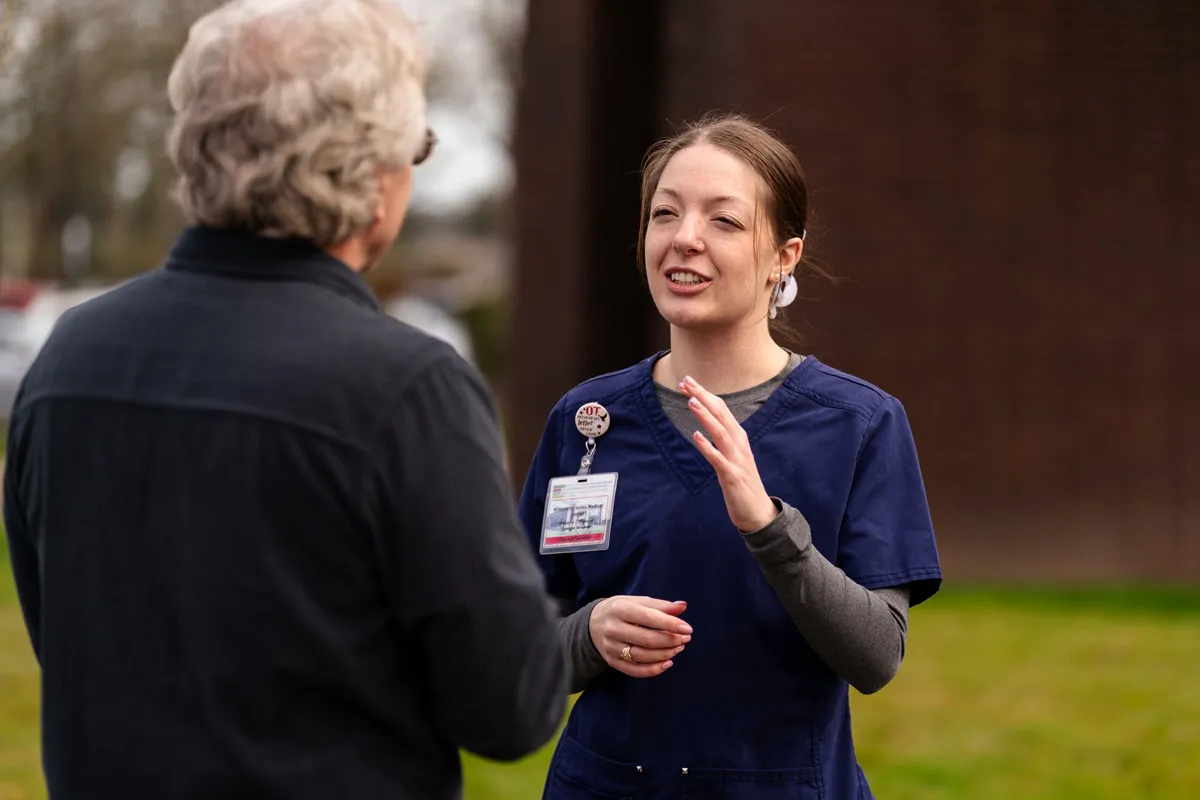
In February of 2024, Clark interviewed with Kate Turner, George Fox’s OT program director. She was impressed with George Fox’s emphasis on holistic care and spirituality. No part of the person went unnoticed or forgotten, and it reminded Clark of what had led her to occupational therapy in the first place: putting patients first.
“I’ve always had a holistic view in my mind of incorporating your mental health with natural ways to do everything. That’s what set George Fox apart for me,” Clark says. “All these other schools were like, ‘Oh, we focus on research,’ but Kate said, ‘No – we're holistic.’”
While she was wrapping up her senior year, Clark interned for an occupational therapist, getting hands-on experience with patients. The more she worked in the field, the more she felt she was on the right path.
“I discovered that, in OT, patient care comes first,” she says. “It's what they want – and maybe you can’t make it completely work, but making parts of it work is what’s important.”
Clark graduated from the University of Idaho in the spring of 2024, earning her bachelor’s degree in medical sciences and her military commission as an Army officer.
She moved to Newberg that August and joined the first cohort at George Fox’s newly launched OT program. One of 14 students in the program, Clark enjoyed how her group truly partnered with the staff to pave the way for future George Fox OT students.
Clark can recall heartfelt moments from nearly every class. Professors, directors, and assistant directors of multiple programs at George Fox frequently stopped by to visit with students and occasionally stepped in to help the cohort with projects. When one of the cohort’s instructors had a baby, Clark’s cohort all chipped in cards, gifts, and countless requests for pictures.
“We all got along, right out the gate,” Clark says with a smile. “A group of us do intramural basketball, soccer, volleyball, and softball together on top of everything else, ‘cause why not?”
And even though the cohort hasn’t had a true break from each other in the past year, they savored every moment together before leaving to complete the fieldwork piece of their training.
A Passion to Assist Veterans
Although saddened about leaving her friends, Clark is excited to continue her future research about neurological conditions – including Parkinson’s.
More specifically, the start of her Capstone research has been focused on the link between environmental factors and neurological diseases like Parkinson’s and Alzheimer’s in veterans. “I did research into veterans with environmental troubles from Vietnam and even World War II, with the environment from things like the gas they were using at that time,” Clark says.
At the heart of Clark’s research is her desire to give veterans, and every person, the ability to live to their greatest capacity. “I want to be someone who can be there for patients, who listens to them, as my lieutenant colonel told me.”
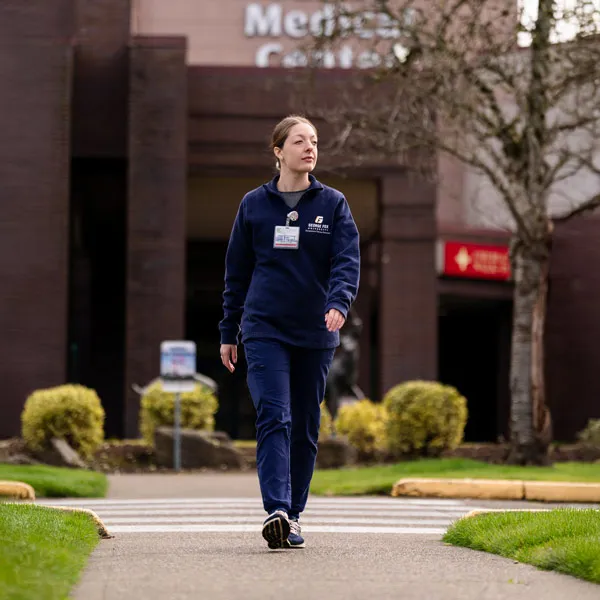
In January 2025, Clark began her full-time fieldwork rotations to work toward her career goals of eventually serving in the military again, helping with neurorehabilitation and military medicine. But rather than lead how others might expect her to, Clark plans to lead how she was made to – with a listening heart.
“‘If you know your strength is empathetic leadership, then lean into that strength because more people respect you.’ That’s what I was told, and it really hit me. Don’t let anyone change that for you.”
Related Posts
Educating the Educators
Todd Bloomquist uses his expertise in brain neuroscience to help equip teachers and promote community wellness in rural Oregon school districts
‘We Work Better Together’: Interprofessional Education at George Fox
George Fox grows innovative leaders through interprofessional education in holistic healthcare.
Occupational Therapy Faculty Spotlight: Stanley Paul
The director of George Fox’s occupational therapy doctorate program opens up about how he got into the profession, his vision for the program, and the one question he asks himself to determine if you’re going to cut it as an OT.
Encouraging Resilience
Occupational therapist Kate Turner returns to the classroom to help George Fox OT students advance their hands-on learning.
The Roads Not Taken
Faculty members Stanley Paul, Trevor St. Clair and Kate Turner didn’t set out to be occupational therapists, but they ultimately couldn’t shake the appeal of the profession
Resilience Personified
Forced to leave her homeland as a teen – and faced with the sudden deaths of family members – school counselor Mirna Pani models for her students what it takes to overcome hardship