
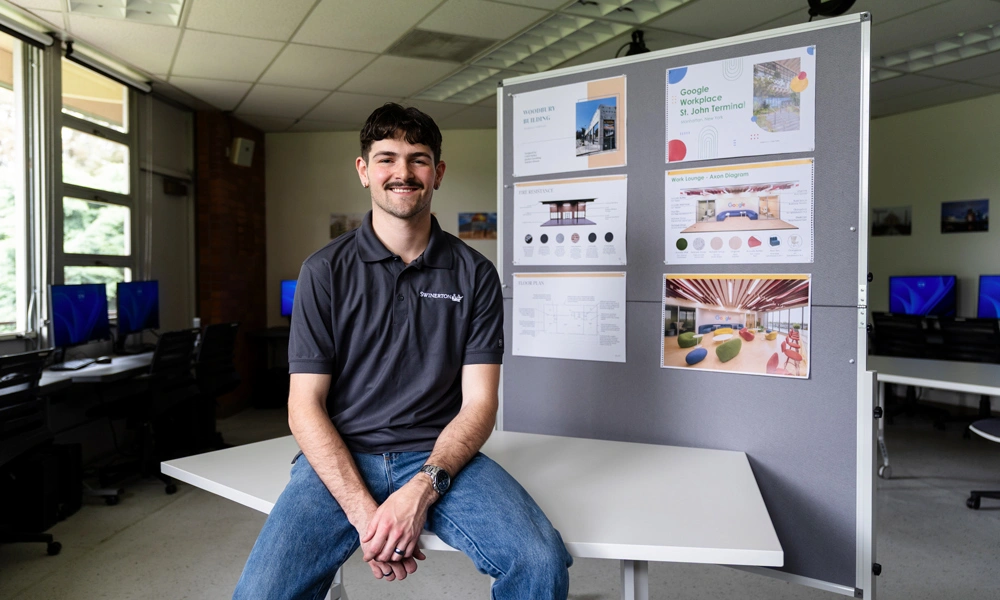
Interior Design Major Discovers a Career Path in Digital Innovation
Through faculty mentorship and tech-forward training, Caleb Parker finds his calling at an industry-leading construction firm
by Brynne Norton
Even before he graduated from George Fox in the spring of 2026, Caleb Parker, an interior design major, got the opportunity to use his education and talents in a professional position that blends the fields of interior design and construction.
Although an interior designer by education, his career path took an unexpected turn his senior year when he was hired to work in construction management as a virtual design and construction (VDC) project engineer for the Swinerton construction company, renowned for its cutting-edge innovation.
It’s not the path Parker originally intended to follow, but Swinerton recognized his potential. “They took a chance on me,” he says.
Innovation in Action
The company, with 24 regional offices across the U.S., including one in Portland, is a frontrunner for integrating digital construction as a standard practice in building. Parker uses digital tools including drones, LiDAR (Light Detection and Ranging) scanners, and augmented reality that allows him to see visual representations of the space being built.
“Visual communication plays a strong role in innovation, and technology strengthens it,” he says. His background in interior design helps him be a good visualizer when looking at a project and prepared him for the challenges of working in the construction field.
“The digitalization of the preliminary steps of construction saves time, money and effort for the entire team of construction workers, designers, architects, electricians, plumbers and everyone else working on a project,” he explains, adding that any problems encountered in the design phase can be eliminated before the project moves forward. “It’s better for all trades, for everybody who’s on the project,” he says.
‘I Believe God Led Me to Fox’
Originally from Ellensburg, Washington, Parker chose George Fox over his second choice, Washington State University. Both schools had reputable interior design programs, but when he reflects on the deciding factor, he says it seems God chose Fox for him. “I was not a Christian coming into college,” he says. “I believe God led me to Fox, because there’s no reason why I would choose here.” Four years down the road, he’s now a Christian and has a new direction for his life.
The interior design program at George Fox is progressive when it comes to technology integration. Parker was unknowingly preparing for his new position in the evolving world of digital construction during his college years. “This [interior design] program has helped me with the introduction of learning new technology,” he says.

Students in the program utilize innovative digital technology, all while being educated in a distinctive class structure professor Casey Martin, an assistant professor of interior design, likens to a design firm. “On the whole, the program is very industry-focused,” she says.
To that end, students complete 12 to 20 real-world design projects a semester. The initial designs are modeled using digital software. “We can use virtual reality and hook that up to what we design in Revit and our rendering software, Enscape,” Parker says. “It creates a clear visual for the client.”
He goes on to describe how this allows designers to make changes in the digital model as needed before time and resources are used on the physical project. “I think the most effective and innovative way forward is eliminating problems before they arise,” he says.
Experiencing the Be Known Promise
Beyond the technical aspects of the program, the university’s signature Be Known promise has resonated with Parker. “[Professor Martin] really cares about each individual student – you’re not just a number,” he says.
Martin, in turn, says he became her go-to person for help. “He’s one of those people who’s just super reliable,” she says. Getting to know her students gives Martin insight into each of their unique strengths and skills, and it’s this knowledge that enables her to personally advocate for them. “She’s the reason for a lot of our success,” Parker says.
Parker cites the fall of his senior year as a time he experienced a period of intense questioning about his career path. He had come to the realization that the work of being an interior designer in the field was not what he wanted to do. “I enjoyed it in school,” he says, “because you don’t have creative restrictions in school. But once you transition into the professional field, it’s very restrictive.”
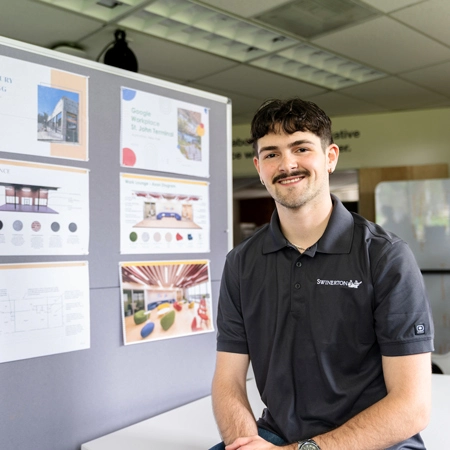
It was professor Martin who stepped in and helped Parker find a new way forward. Together, they reached out to multiple construction companies, and thanks to Martin’s professional connections and her ability to speak to Parker’s character and skills, she was able to assist him in getting hired at the Swinerton firm in Portland.
The Future Looks Bright
His experience at the company has been overwhelmingly positive. “I really love the people that I work with,” he says. “I really enjoy what I’m doing. There’s a need for digital construction within standard construction practices, and having a design background definitely helps.”
Having found his place, he sees the job as a blessing. For younger college students who might go through struggles and epiphanies about their career plans, Parker wants to provide mentorship and inspiration. His own story shows that it’s not over if your road changes course. Being able to find a new path in his senior year of college taught him that, when it comes to the future, the sky is the limit.

Related Posts

Jules Stafford: Interior Designer Leans Into the Power of ‘We’
Interior design alumna Jules Stafford shares her passion for creating hospitable spaces for diverse communities to come together.

Student Activities: The Ultimate ‘What to Bring’ Guide
Student activities are one of my absolute favorite things about being a student at George Fox. There is something fun to participate in almost every single week. I remember being a freshman, having not gone to any activities yet, and being so nervous about what I should wear, or if I had packed enough things for these events. So, what should you bring to be prepared for student activities?


2026 Update: Interior Design Program Wins National Honor – Again
For the third time in four years, George Fox University's interior design program earns national recognition for its role in applying design solutions to real-world problems

How Students Get Career Ready at an Interior Design School
Watch and listen as professor Casey Martin and her students reflect on the value of gaining real-world experience in George Fox’s interior design major.

A Way Out, A Way Forward
After years of homelessness and addiction, Tia Renner found sobriety, purpose and an unexpected path to law school, pursuing her dream to become a voice for others