

The Courage to Let Go: Helping Your Student Thrive During the College Transition
Few parenting milestones carry the same mixture of pure pride and emotional whiplash as college move-in day. Even after 38 years in higher education nothing quite prepared me for the wave of unexpected feelings I experienced when dropping off my own daughters at college.
by Brad Lau
For nearly two decades, you've been their teacher, coach, encourager, chauffeur, proofreader, problem-solver and biggest fan. You've celebrated milestones, picked them up after disappointments, prayed over difficult decisions, and helped them become the person they are today.
Now comes one of the most important parenting transitions you'll ever make: learning to let go.
If you're feeling excited, proud, nervous, and maybe even a little heartbroken all at once, you're not alone.
At George Fox University, we understand that Welcome Weekend isn't just a beginning for students. It's a beginning for parents, too. And we want you to know something from the very start: We're partners.
You've spent years preparing your student for this next chapter. Now you've entrusted them to us, and we consider that both a privilege and a sacred responsibility. Our commitment is to help every student flourish academically, socially, emotionally and spiritually while keeping you informed, encouraged and confident along the way.
A Community That Knows Your Student
One of the greatest misconceptions about college is that students are suddenly on their own. That isn't how George Fox works. Our philosophy is simple: high challenge paired with high support.
College should stretch students. It should ask more of them academically, socially and personally than high school ever did. Growth requires challenge. But students shouldn't face those challenges alone.
Behind every Bruin is an entire community committed to helping them succeed. Professors become mentors. Residence life staff walk alongside students daily. University pastors nurture spiritual growth. Our health and counseling services workers provide care during difficult seasons. The Intercultural Resource Center creates spaces of belonging. Coaches, student leaders, campus safety personnel, career advisors and dozens of other professionals all work together with one shared goal: helping students become the people God created them to be.
This is what it means to be known.
Letting Go Isn't Losing Them
Whether this is your first child leaving for college or your last, this transition changes your life, too. It’s OK to acknowledge that.
For years you've been deeply involved in nearly every aspect of your student’s life. You knew their schedule, reminded them about assignments, helped solve conflicts, celebrated victories, and offered comfort after disappointments. That season has been meaningful.
But parenting has never been about keeping children dependent forever. From the very first day of kindergarten until the first day of college, every stage has prepared them for increasing independence. College is simply another important step in that journey.
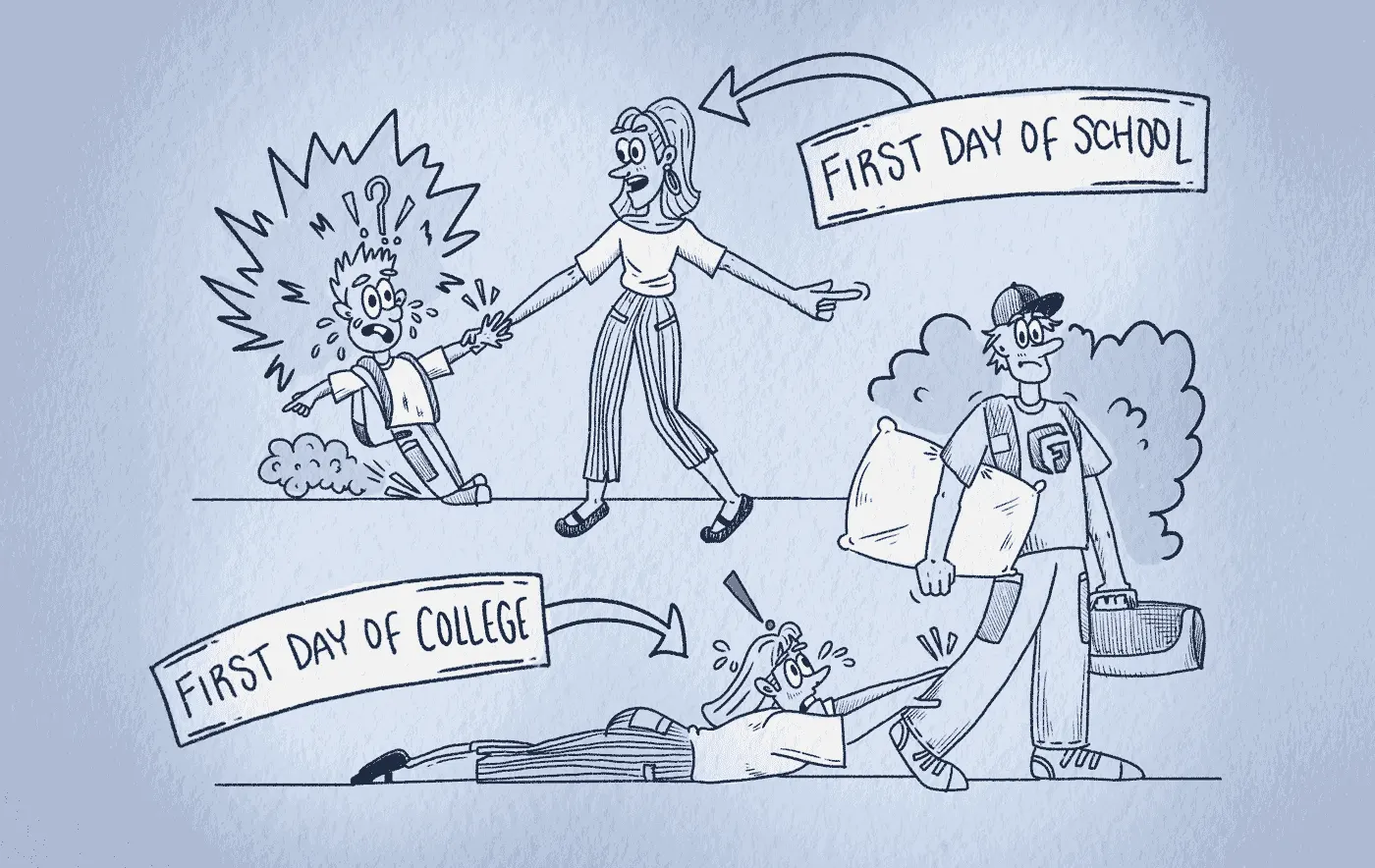
It may feel like you're letting go. In reality, you're giving them one of the greatest gifts possible: the opportunity to become the person they were created to become.
Understanding the Three Stages of the College Transition
While every student is unique, decades of research show that the transition into college tends to follow a fairly predictable pattern. Knowing what to expect can help you respond with wisdom rather than worry.
Stage One: Transition
This stage often begins during senior year of high school and continues through the first several weeks of college. Everything feels new. Students are excited, anxious, hopeful, and uncertain – all at the same time. They're navigating a new environment, new expectations, new friendships, and new routines.
Parents often feel many of those same emotions. This season is full of anticipation because everyone recognizes that life is changing.
Stage Two: Separation
For many families, this is the hardest stage.
During the first semester, students begin building new friendships and establishing new routines. They develop inside jokes, campus traditions, and even a new vocabulary filled with college acronyms and experiences that didn't exist just weeks earlier.
At the same time, they may also experience homesickness, loneliness, self-doubt or disappointment. A poor exam grade. A difficult roommate. Missing home. Wondering whether they made the right decision.
Some students talk about transferring. Others want to come home every weekend. Some simply question whether they belong. These moments are more common than many parents realize.
Your role during this stage is incredibly important. Be their anchor – not by solving every problem, but by reminding them that they can do hard things. Continue telling them, “You belong there. We're proud of you. Keep going. We believe in you.” Often, what students need most is not an immediate rescue but steady encouragement to work through the challenge.
Stage Three: Integration
Eventually something beautiful begins to happen. Campus starts to feel like home. Students become confident navigating classes, friendships, campus traditions and responsibilities. They begin seeing themselves not simply as visitors but as full members of the George Fox community.
For parents, this can bring mixed emotions. The place that once belonged exclusively to your family now has another home alongside it. That can sting. But it also means you’ve succeeded. It means your student is becoming independent while still knowing they have a family that loves them unconditionally.

The Four Ways Students Grow During College
College is about much more than earning a degree. The most important growth often happens outside the classroom.
They Develop Competence and Confidence
Many students discover that the study habits that earned excellent grades in high school no longer work in college. That's normal. Growth often begins with struggle. As students learn new ways to study, seek tutoring, visit professors during office hours, and persevere through challenges, they build confidence that extends far beyond academics.
As retired Admiral William McRaven famously observed in Make Your Bed, lasting success is often built through consistent, ordinary habits. Small acts of responsibility create resilience for life's bigger challenges.
They Learn Healthy Independence
Every student arrives with a different personality. Some are naturally independent and hesitate to ask for help. Others lean heavily on parents or friends for every decision. Neither extreme leads to long-term flourishing.
Our goal is interdependence – a healthy balance of confidence, humility, responsibility and community. Students learn to make decisions, set healthy boundaries, ask for help when necessary, and contribute meaningfully to the lives of others.
They Discover Their Identity and Purpose
A true story I stumbled across a couple years ago really illustrates this point. It described a scene at a greyhound racetrack. For those like me who have never seen a greyhound race, a mechanical rabbit on a motorized rail speeds around the track to lure the dogs. These greyhounds are bred and trained around a single rule: run down that fake rabbit. It is their whole reason for being.
The race started with textbook precision. The gates snapped open, sending a surge of raw speed and hyper-focused energy down the stretch, every gaze locked on the target. But on the first turn, disaster hit. An electrical short flared up, and the mechanical rabbit literally detonated. Poof! A fraction of a second transformed their prize into a sad scrap of fluff on a metal arm.
The aftermath was mass confusion. These top-of-their-game elite dogs stood there completely paralyzed. The single objective governing their existence had vanished into thin air. Several dogs gave up on the spot, sinking into the dirt with an air of total defeat. A few raised their heads to howl at the bleachers in despair. And one brilliant dog – my favorite of the bunch – started chasing his own tail, figuring, “I have to chase something, right?” When the dust settled, not one dog crossed the finish line.
It's a humorous story with a profound lesson. All of us need a meaningful “why.” College is one of the first seasons when students begin asking life's biggest questions:
Who am I?
What gifts has God given me?
How can I use them to serve others?
What kind of life am I called to live?
Finding those answers takes time. It's perfectly OK if your student doesn't know exactly what career they want or where they'll ultimately land. Exploration is part of the journey.
They Build Character
Success at George Fox isn't measured solely by GPA, internships, or starting salaries. Character matters deeply. Integrity matters.
At the heart of George Fox is a Christ-centered mission that shapes everything we do. While our students arrive from a wide variety of faith traditions – or no faith background at all – we openly share our core conviction: A relationship with Jesus brings ultimate meaning, purpose and direction to life. It answers that profound “why” every student is searching for.

Our hope is that through their time here, every student is transformed – not just in what they know, but in who they become. We aim to graduate young adults of wisdom, compassion, courage and humility, fully prepared to love others well and bring light, healing, and meaningful impact to communities that desperately need them.
How Parents Can Help Without Taking Over
One of the biggest adjustments for parents is recognizing that your role changes – but it doesn't become less important. In fact, your influence may become even more meaningful.
Here are a few practical ways to support your student.
Listen before solving
Sometimes students simply need someone who will hear them without immediately offering solutions. Try saying,
That sounds really difficult.
Tell me more.
How are you feeling about it?
Ask coaching questions.
Instead of fixing every problem, help students think through their next step. Ask:
What do you think you should do?
Who on campus could help?
Have you talked with your professor, coach or resident assistant?
These questions encourage the self-advocacy they'll need throughout life.
Resist the urge to intervene.
Whether it's a roommate disagreement, academic concern or a scheduling issue, your first instinct may be to step in. Instead, encourage your student to have the conversation first. Learning to navigate conflict, asking for help, and solving problems are essential life skills that can't be developed if someone else always steps in.
Don't panic after the "dump call."
Many parents receive the dreaded phone call where everything suddenly seems terrible. A bad test. A difficult roommate. No friends. Regret.
Remember that students often call home at the emotional low point of their day. Listen. Encourage. Pray. Then wait before assuming the worst. Many situations feel dramatically different 24 hours later.
Keep pointing them toward hope.
Perhaps the greatest gift parents can give during this season is steady confidence. Your student needs to hear:
You can do this.
We're proud of you.
God is with you.
We're always here for you.
From Anchor to Harbor
To leave you with a final thought, one picture beautifully captures the sacred shift taking place in your family right now.
For many years, you've been the anchor. You provided the ballast that kept your student safe while preparing them for the realities of adulthood. You felt every tide and tremor of the "ship" you were so closely attached to.
Now, as you entrust them to our campus community, your role evolves. You become the harbor and lighthouse. A true harbor never traps a vessel in port; it exists to give ships a secure place to rest and recover when the waters get choppy. A lighthouse stands tall, bright and constant – a reassuring sight on the horizon that reminds the traveler who they are and where they came from as they push into deeper, uncharted waters.
Letting go of the anchor chain may feel heavy, but it is also a moment of sacred release. The goal of parenting has never been to keep our children sheltered in the bay forever. It has always been to raise up young men and women of purpose, integrity, and faith – and then step back, cheer them on, and watch them sail.
Thank you for trusting George Fox University with this remarkable season in your family's story.
We're honored to partner with you as your student discovers who they are, who God is calling them to become, and how they can make a meaningful difference in the world.
Welcome to the Bruin family!

Related Posts

The Healing Power of Design
A one-day trip to the fire-ravaged area of Altadena, California, gave 19 interior design students a firsthand look at the devastation of a community – and the hope they can offer families and businesses displaced by the flames

New Art and Cinematic Arts Building Set for Fall 2025 Opening
The long-anticipated construction of a new art and cinematic arts building is proceeding this summer and will launch a new era of creativity and collaboration when its doors open this fall.


What's On-Campus Work Like?
Working while being a full-time student may seem impossible. Somedays it feels like you have the extra time to work, other days not so much. If you find you need to work while going to school, consider first working an on-campus job.
Financial Planning Program: What You Need to Know
With many financial planners reaching retirement age and the baby boomer generation in need of financial consultation, professional opportunities are plentiful. Factor in the aftermath of the 2008-09 financial crisis – and the cynicism toward corporate and investment banking that resulted – and you can understand why ethical and competent financial planners are in high demand.

Need Extra Cash? Seeking Work Experience? Explore the on-Campus Job Possibilities
There are many ways for students to contribute to this special place, learn skills, and earn a little cash to keep mini fridges stocked and coffee budgets generous. And yet, when I was a freshman, I had no idea where and how my friends were finding on-campus jobs.