

The AI Problem Institutions and Students Aren’t Seeing Yet … But Will
At conferences, roundtables and meetings, I ask folks what they think the biggest challenge with AI is. Their proclivity is usually to point to bias, trust, ethics, accuracy and job loss – all valid concerns, but none of them touch the deeper issue I keep seeing in the companies I work with.
by Ryan D’Souza, MBA Advisory Board Member
At the core, the real problem isn’t that AI is too powerful. It’s that AI is making decisions – and costly capital ones, I might add, faster than leaders can govern them. Here’s the part institutions don’t realize: Research from MIT’s Project NANDA found that despite $30-40 billion in enterprise investment into Generative AI, 95% of organizations are getting zero return from those initiatives (MIT Project NANDA, 2025). That should stop anyone in their tracks.
Most people don’t see the underlying cause. They are being fed a steady diet of marketing fluff about “intelligence,” and everyone is jumping on the bandwagon. But intelligence alone is half the story. And without governance, intelligence becomes drift – and drift becomes damage.
20+ Years of Watching and Learning the Same Pattern
My career has been one long progression through the eras of enterprise intelligence. I didn’t plan it that way; it just unfolded. I’ve always been drawn to solving hard problems, and that curiosity carried me through research and development, leadership and execution where I saw the same pattern repeated over and over.
I started in the Business Intelligence (BI) space, helping companies see their data more clearly. Dashboards were a big breakthrough. If leaders could see the numbers, they believed they would make better decisions. However, visibility didn’t solve the deeper issues. This was the “Descriptive Intelligence” era – “Big Data” everywhere, collecting, coalescing a plethora of data, and storing everything as a system of record. Useful but not transformative.
Then came “Predictive Intelligence,” the so-called “system of insight.” We tried to anticipate what might happen with a high degree of efficacy. It felt like progress. But prediction didn’t fix inconsistency, drift, or even misalignment. It didn’t stop decisions from wandering when uncertainty hit.
Eventually we progressed into Prescriptive Intelligence – the early AI systems that recommend what should happen. These systems generate answers, but still not enough. They didn’t enforce discipline. They didn’t prevent drift. They didn’t align actions with mandate or risk.
What I noticed and what surprised me was that the more intelligent our models became, the more uncertainty amplified. Intelligence didn’t reduce complexity. It magnified it. And that’s the moment I realized we weren’t dealing with an intelligence problem. We were dealing with a control problem.
What Became Obvious
Over the years, I realized something simple but transformative: Intelligence alone does not stop drift. It doesn’t enforce discipline. It doesn’t keep decisions aligned when uncertainty rises. The industry keeps building smarter tools, but smarter tools don’t preclude organizations from facing the same structural failures – inconsistent decisions, violated constraints, misaligned mandates, and breakdown in discipline when volatility hits.
Earlier eras of enterprise intelligence, business intelligence, Big Data, and analytics helped leaders see more and predict more, but they didn’t solve the structural problems enterprises face during uncertainty: drift, inconsistency, violated constraints, and breakdowns in discipline.
Take finance, a story many people remember and lived through. During the 2008 Global Financial Crisis everything went wrong at once: inflated valuations, reckless leverage, tightening credit conditions, distorted bond markets, and yes, greed. The stock market collapsed and took one of the worst dives in history. Investment teams lost billions. People lost their life savings.
I remember thinking, “How could institutions with so much intelligence firepower (people, process, technology) fall this hard?” The answer was painfully simple: When volatility spikes, decision drift follows. Every enterprise leader experiences this. And unless leadership can govern decisions under uncertainty, drift becomes damage. It wasn’t intelligence that failed. It was the absence of a governed decision control layer above that intelligence. And this pattern repeats in every industry – aerospace, energy, manufacturing, healthcare, operations and more. When uncertainty rises, drift rises with it.
My postulate became clear: The next evolution isn’t more intelligence. It’s control. Intelligence will always be subordinate to control.
Think about a rocket. What does it need the most to land on the moon and return safely? Not more intelligence. Rockets already have all the intelligence in the world. What keeps them safe is control – the guidance system, the safety system, the closed-loop feedback that prevents drift. Cars, ships, autonomous vehicles, mission-critical infrastructure. All of them rely on control, not raw intelligence. Capital is no different.
The Shift From Intelligence to Control
That’s when I started sketching what eventually became Capital Decision Control Infrastructure (CDCI), not as a theory, but as a practical way to stop organizations from drifting when things get unpredictable. We built CDCI by adapting principles used in aerospace, energy-grid, and mission-control systems and applying them to enterprise decisions.
Simply put, we built the steering and brake layer of intelligence, including AI – the part that governs what intelligence does, not just what it predicts and prescribes. Here’s a simple example from our own research.
Between 2000 and 2026, we compared two identical portfolios – same stocks, same market, same conditions. The only difference was governance.
The traditional portfolio followed raw intelligence and market signals. The governed portfolio applied exposure boundaries, risk pathways, volatility interpretation, and execution checkpoints. The result was dramatic: During the Dot-Com Bust, the S&P 500 fell 53% while the governed portfolio fell only 2%. During the Global Financial Crisis, the S&P dropped 59% while the governed portfolio dropped 7%.
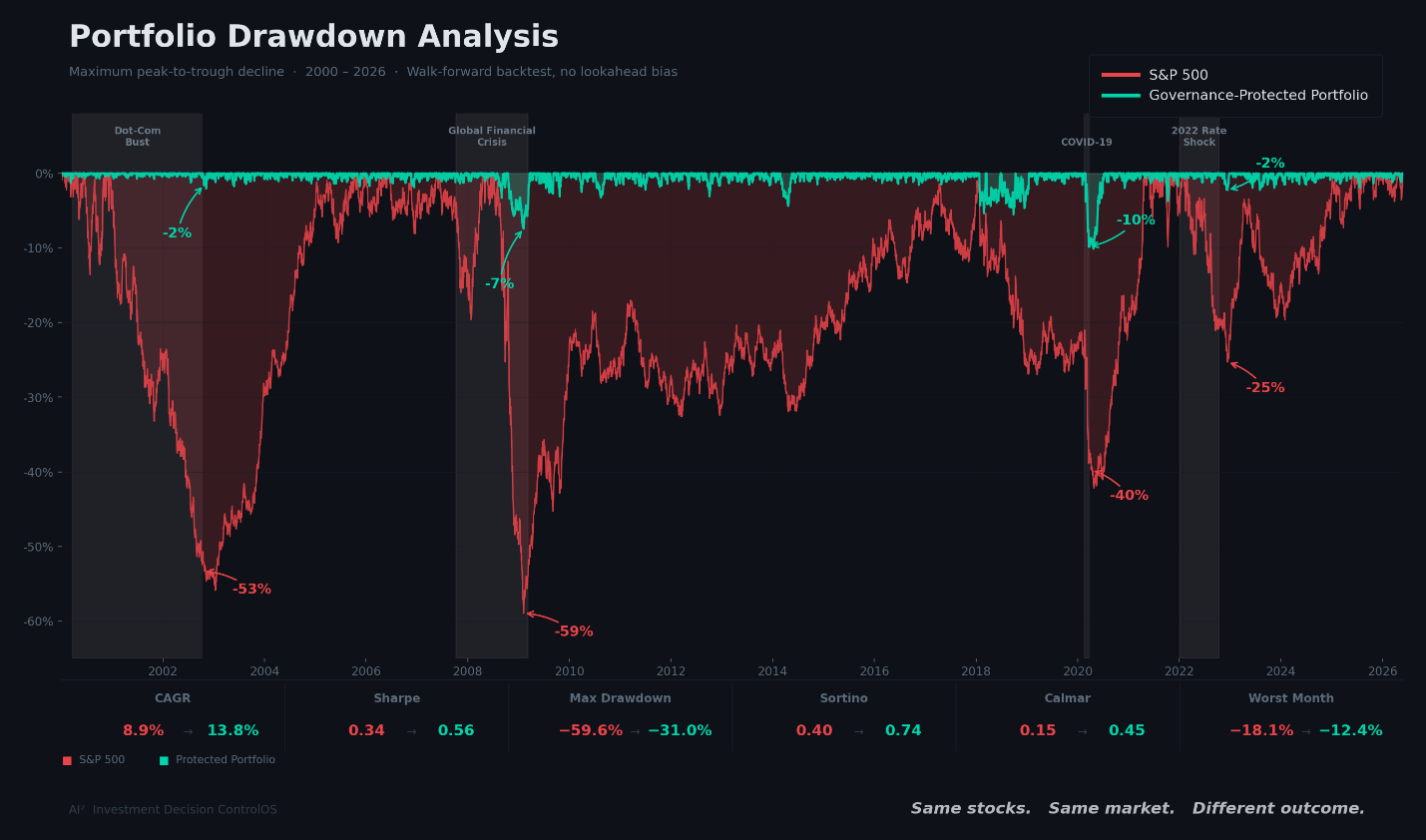
Same intelligence. Same market. The difference was control. This is what CDCI does; it governs decisions, so drift doesn’t become damage.
We believe the next enterprise era isn’t more intelligence – it’s about decision control, which addresses a massive problem of decision drift and reduces AI hallucinations. Acumentica was built to deliver this evolution.
Precision AI: Intelligence with the Control-Loop
Institutions keep running into the same problem: Intelligence breaks down when uncertainty rises. That’s why we developed Precision AI.
Making intelligence context-aware was a meaningful step forward. But even then, one challenge remained: Institutions still needed a governed system that keeps decisions aligned when conditions change. Precision AI brings the intelligence; CDCI brings the control. Together, they help leaders stay disciplined, reduce drift, reduce AI hallucinations, and make decisions that hold steady under volatility.
Why This Matters for George Fox MBA Students
At the end of the day, it’s the decisions you make that make a difference. Your decisions impact a business, an organization, an enterprise in many different facets. Decision-making is how leaders understand the problem and know how to give the best palpable answers.
AI tools are intelligent. They generate answers, but they are not risk-aware, they don’t understand your objectives, and they don’t know your mandate. Two people asking the same question will get two different answers, because the system doesn’t understand you.
As MBA students, the workforce won’t ask you to “generate answers.” They will ask you to solve problems. And that’s where George Fox University stands apart. George Fox is not teaching you merely how to use AI tools. They are preparing you to make decisions under uncertainty. You move from theory to practice to leadership. And that’s where decision control comes into play.
You will stop seeing AI as a technical subject. You start seeing it as a leadership responsibility. You begin asking better questions – the questions leaders ask:
- “Where does drift actually happen?”
- “What decisions carry the most risk?”
- “How do we enforce constraints before decisions are made?”
- “How do we design systems that don’t fall apart during volatility?”
These are not technical questions. These are leadership questions. And this is the literacy employers are asking for – the ability to govern decisions, prevent drift, reduce AI hallucinations, and lead organizations safely through uncertainty. George Fox students will learn this first.
Takeaway
You’re entering a George Fox program where professors know you personally, invest in your growth, and prepare you to lead under uncertainty. Don’t just understand AI; understand how to govern decisions under uncertainty. That’s the difference. That’s the separator. That’s what will prepare you to lead in a world where everyone is chasing intelligence but very few understand control.
Every one of you has an opportunity to shine – to differentiate yourselves as the next generation of practitioners of decision-making, not just users of tools. The market is ripe for leaders who understand decision drift, AI hallucination, and governed decision control, and George Fox is one of the few institutions preparing you for that reality.
Sources
D’Souza, R. (2024a). Capital Decision Control Infrastructure: The Governance Layer for Enterprise AI. Acumentica Decision Control Research Lab Series. https://acumentica.com/capital-decision-control-infrastructure/
D’Souza, R. (2024b). Decision Control OS: The Closed-Loop Operating Layer for Institutional Decision Making. Acumentica Decision Control Research Lab Series. https://acumentica.com/decision-control-os/
MIT Project NANDA. (2025). The GenAI Divide: State of AI in Business 2025. MIT. https://www.artificialintelligence-news.com/wp-content/uploads/2025/08/ai_report_2025.pdf

Related Posts

Your AI Program Is Solving the Wrong Problem
One of the most common challenges organizations face today is why so many AI initiatives struggle to move beyond the pilot phase.

Stop Using AI as a Tool. Start Building an AI Operating System.
The more important question for a system is this: How is AI improving the way your business operates?
Marlon Ware: Educating the Entrepreneurs of Tomorrow
Marlon Ware became fascinated with the concept of business at a young age. While other children in his neighborhood were outside playing games and goofing off, Ware fondly remembers organizing and launching his very first business: a lemonade stand.

The Artificial MBA? Ask Who You Become, Not What You Gain
In an age where machines seem to do more and more of the thinking, it’s vital we continue to be critical, original thinkers – and not to fall into the ‘good enough’ mentality where AI does all the work

‘Even when it gets dark, there is still hope’
By caring for the whole person, PsyD student Manesha Ram leads people to a place of healing and peace. Manesha Ram was intent on pursuing a career in nursing until she changed somebody’s life simply by listening.
I Built an AI Agent That Reads Everything So I Don't Have To
Staying current in your field means newsletters, blogs, news sites, and analyst notes, and nobody has time for all of it. Here's the agent I built to read them for me.