

Stop Using AI as a Tool. Start Building an AI Operating System.
The more important question for a system is this: How is AI improving the way your business operates?
by Carl J. Cox
Ask a leadership team how it is using artificial intelligence, and the conversation often begins in the wrong place. It begins with software: Which platform did we purchase? Who has access to it? Which department is experimenting with it?
Those questions may sound strategic, but they mostly tell us what the company has purchased, not what it has changed. The more important question is this: How is AI improving the way your business operates?
Is it helping you sell more, serve customers better, make faster decisions, improve margins or remove a constraint that has been holding the company back? Having access to AI is not the same as creating value with AI. A larger toolbox does not automatically build a better business.
Every Business Revolution Has Its Tools
I have spent the past 30 years working inside and alongside privately held companies, family-run businesses, private equity-backed organizations and publicly traded companies. My roles have often sat at the intersection of finance, strategy and operations, giving me a front-row seat to several waves of business transformation.
In the 1980s and 1990s, much of the business conversation centered on machinery, automation and computer systems. The next wave brought outsourcing and offshoring. Then came websites, search engines, e-commerce, social media and online advertising.
Every wave created opportunity, but every wave also created expensive distractions. The businesses that benefited most were not the ones that adopted the most tools. They connected those tools to a clear strategy, an operational need and a measurable result.
AI raises the stakes because it can influence almost every part of a business at once. It can affect finance, sales, marketing, operations, customer service, recruiting, training, product development and executive decision-making. It can help an employee complete a task faster, but it can also connect information, decisions and workflows across an organization.
That makes AI exciting. It also makes it easy to lose sight of the goal.
The AI Spending Race Is On
The amount of money flowing into AI is staggering. The Wall Street Journal reported that the combined capital spending of Google, Microsoft, Amazon and Meta was expected to reach $710 billion in 2026. Another Wall Street Journal report said large technology companies were expected to spend $3 trillion on AI through 2028.
Those figures do not include the subscriptions, consultants, training programs and pilot projects funded by thousands of other organizations. The AI revolution is not short on investment or executive attention.
But investment does not guarantee a return. Buying AI does not make a company AI-enabled any more than buying a treadmill makes someone physically fit. You must build the habits, follow a process and measure the results.
Do Not Forget the Goal
My background is rooted in finance, but I have learned that finance cannot be separated from strategy and operations. The financial statements are the scoreboard. Strategy determines where the company is trying to go, while operations determine whether it can actually get there.
That is one reason The Goal by Eliyahu Goldratt and Jeff Cox has remained one of my favorite business books. The story follows Alex Rogo, a plant manager whose factory appears busy and productive. The machines are running, employees are working and reports are being generated. Everyone can point to activity, yet the business is still losing money.
Goldratt’s Theory of Constraints brings the organization back to a simple principle: The goal of a for-profit company is to make more money. That requires increasing throughput while managing inventory and operating expenses.
The lesson is highly relevant to AI. Employees may create more presentations, marketing teams may produce more content, meetings may be summarized automatically and managers may receive more reports than ever.
But has revenue increased? Have margins improved? Are customers receiving better service? Has the sales cycle become shorter? Have you increased capacity without allowing costs to rise at the same rate? Are leaders making faster and better decisions? Is cash flow stronger?
If the AI tools you implement do not eventually improve the bottom line, what have you really gained? You may have created more activity without creating more value.

From AI Tool to AI Operating System
An AI tool helps someone complete a task. An AI operating system changes how work moves through the organization.
A salesperson who uses AI to write an email may save a few minutes. A company that uses AI to identify qualified prospects, research their needs, recommend the next action, prepare personalized outreach, update its customer relationship management system and measure conversion rates is beginning to build an operating system.
The same distinction applies in finance. An accountant who asks AI to summarize a report is using a tool. A company that uses AI to review transactions, identify unusual variances, forecast cash flow and prepare insights before the monthly financial meeting has changed its operating rhythm.
A manager who uses AI to summarize meeting notes has improved one task. A leadership team that uses AI to capture decisions, assign accountability, monitor key metrics and identify missed commitments is building something more powerful.
The goal is not to remove people from the business. It is to create a system in which people and AI work together to produce better outcomes. That requires leadership, priorities, processes, accountability and measurement.
Leadership Must Own the Transformation
AI Expert, Trent Gillespie, founder of Stellis AI and a former Amazon executive, describes this broader approach as Operational AI. He summarizes the leadership challenge directly:
“Your AI transformation isn’t stalled because of technology. It’s stalled because no leader owns it.”
Meaningful transformation cannot be delegated to a few enthusiastic employees experimenting from the bottom up. It requires an executive sponsor, an educated leadership team, an internal AI champion and a recurring rhythm of focused AI sprints.
That word, rhythm, is important. A company does not transform through one training session, one pilot project or one successful prompt. Transformation happens when the organization develops a repeatable way to identify opportunities, test ideas, implement what works and measure the results.
Stellis describes this as moving from scattered experimentation to an operational capability, embedding AI into daily work, core processes and decision-making with clear ownership and a regular cadence.
Trent’s AI SPRINT framework provides a useful progression: Spark action, Position to win, Rally the team, Integrate AI, Enable innovation and Trailblaze growth. Notice that integration does not come first. Leadership, strategic positioning and employee alignment must happen before a company can turn AI into a sustainable operating capability.
Start With the Constraint
You do not need to rebuild your entire company next Monday. Start with one constraint.
Where is work getting stuck? Where are customers waiting? Where are employees repeating low-value tasks? Where are mistakes reducing margins? Where is information arriving too late to support a good decision? Where are the leads being lost?
Once you identify the constraint, ask four questions: What business result are we trying to improve? How could AI redesign the workflow rather than simply accelerate one task? Which decisions and relationships must remain owned by people? Which financial or operational metric will prove that the new system worked?
Establish a baseline, run a sprint and test the redesigned process. Measure the result, keep what works and adjust what does not. Once the system produces a measurable improvement, move to the next constraint.
That is how AI becomes an operating system rather than an expensive collection of digital tools.
Keep Your Eyes on the Scoreboard
The winners of the AI revolution will not necessarily be the companies with the largest technology budgets. They will be the companies that connect AI to their strategy, workflows, people and financial scoreboard.
These organizations will use AI to increase throughput, improve decisions, serve customers, strengthen margins and create new forms of value. They will still explore tools and encourage experimentation, but they will not confuse motion with progress.
Do not measure AI success by the number of prompts entered, licenses purchased, reports generated or pilot programs launched. Measure the outcomes that matter to the business.
The future will not belong to companies with the most AI tools. It will belong to companies that learn how to operate differently because of AI.

Related Posts

Why Should Students Live on Campus as Upperclassmen?
As students advance in their college careers, many assume it’s time to move off campus as upperclassmen. However, according to Emma, Emily, Tori, and Whitney – four seniors who’ve lived on campus as long as they’ve been at Fox – there are some benefits to living on campus for the duration of your college experience.

A Father’s Love
From hospital housekeeper to pediatric nurse, Noriel Sanchez’s ongoing journey to care for his son put him in a position to help other kids as well

11 Reasons to Consider Returning to College as an Adult
Director of George Fox University’s Adult Degree Programs, Jennie Harrop, addresses why joining the Adult Degree Program will will exceed expectations, and why it's nothing to be feared.

A Lasting Impact
Three professors retire this summer after serving a combined 91 years at the university
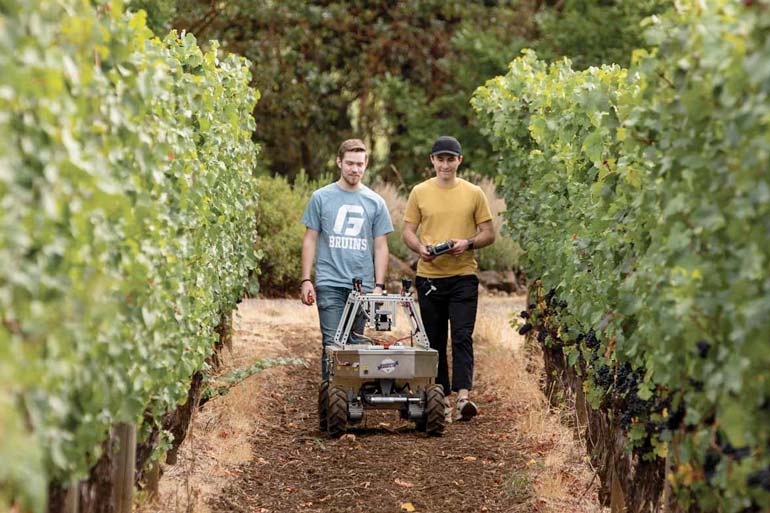
Grapes of Math
George Fox computer science and engineering students are developing an autonomous robot that could drastically change the way vineyard owners predict their harvest

On Becoming an RA
I was nervous when I first set foot on George Fox’s campus. My heart was beating hard, and my senses were overwhelmed with wave after wave of new information. I’m from Southern California, and I had never been to George Fox before move-in day, not even to visit. I was 978 miles away from home, and I felt like a fish out of water.