
Addiction to Restoration: A Veteran's Second Chance
MSW student Kasey Winborne draws on lived experiences to counsel others through life’s darkest moments.
by Kinsey Burke
A lot of people experience hard times, whether it’s the challenge of keeping up with classes or finding their first job. But veterans and survivors of addiction have a very different challenge in front of them: learning to find joy and direction again.
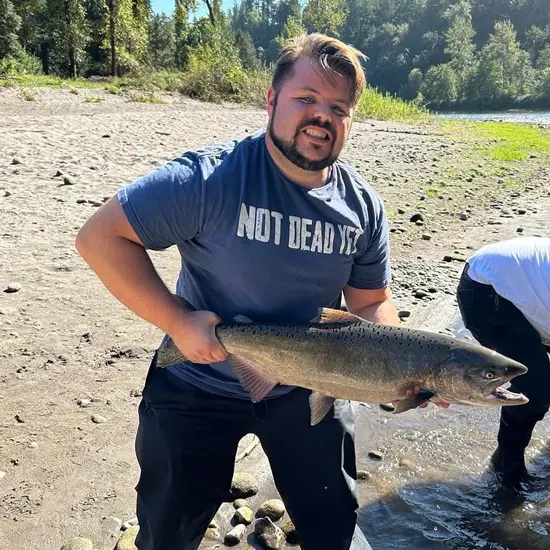
Kasey Winborne, 37, is a veteran and a father to five kids. After spending some years struggling with addiction, he’s turned his focus toward living well and giving back to his communities. Driven by a deep passion for helping others via social work, Winborne earned his bachelor’s degree in social work from George Fox and is now working on his Master of Social Work degree.
When he first came to George Fox, Winborne faced several challenges. As a father, a veteran and an adult in his mid-30s, he sometimes found it difficult to connect with younger students. But friendly encounters at Hadlock helped break the ice, and staff members were more than happy to work with his busy schedule.
He says Erin Johnson, associate dean of behavioral health sciences, Kathryn Saunders, professor and director of the BSW program, Jason Filetta, inclusive excellence chief diversity officer, and Dave Johnstone, director of commuter life, are “models of what, in my opinion, true Christians are about.”
“Dave is really invested in the veteran population at George Fox,” Winborne says. “He hosts veteran luncheons that give us a chance to have a good lunch and just talk amongst each other.”
Winborne was looking for a lot of things when he first applied to George Fox, such as structure and strong values. “I wasn't choosing it just because I was a Christian,” Winborne says. In fact, he holds some views that differ from his classmates, but everyone is very accepting and encourages him to communicate his perspective without fear of being judged – a skill that’s key in the field of social work.
George Fox has also kindled a deep passion for social work. “I realized that I wanted to give back to my communities,” Winborne says. “That’s something that really means a lot to me – to be able to give back in a way that has a positive impact on people.”
Reaching this point hasn’t been easy for Winborne. Growing up in North Portland and struggling with poverty, Winborne experienced a lot of trauma in his childhood, leading to addictions and other issues. With no direction in life, he enrolled in the military, which sent him to Afghanistan in 2009.
As it turns out, surviving the battlefield wasn’t the hardest part of his experience as a veteran. It was returning home.
“Those moments as an addict were the darkest moments of my life – even darker than my combat experiences,” Winborne says. “In combat, at least I knew who my enemy was.”
For a long time, he relied on his addictions and the sheer will he had learned from his days as a veteran to push through his pain. “In war, there is no pause button,” Winborne says.
But eventually, the problems and trauma that he’d experienced caught up with him. “I had to make a change in my life,” Winborne says. “That was when I quit drinking alcohol and started to really think about what a higher power means to me.”
Now sober for four years, Winborne has discovered how to manage his life better than before. “I can take my experience, my strength and my hope and bring it into what I want to do for veterans and for people in recovery,” he says.
Through clinical-style social work, group therapy sessions and individual therapy, Winborne has learned a lot of ways he can help people. “I can go through all these options in the MSW program,” he says. “Maybe I’ll even go into private practice one day.”
As a social worker, Winborne believes the most important thing he can do is meet people in their times of need. And he’s grateful that George Fox is providing that opportunity.
“I hope that people who look at what I'm doing realize that anybody could do it. And I can tell my kids that too: ‘If I can go to college and get an education, so can you.’”
Advice for Social Work Students
Besides paying attention in school to become good at their jobs, Winborne advises social work students to prepare themselves mentally. “Social work is a selfless job that requires us, as professionals, to be prepared for disappointment, along with all the positive things we will experience. Have a plan for self-care. Self-care should be a part of everyone’s daily plan, especially social workers.”

Related Posts

Instilling a Sense of Worth
Social worker Tina Deleon Guerrero lends her voice to the unseen, unheard and unnoticed as she advocates for vulnerable populations

MSW Student Turns Her Pain Into Purpose
Brooke Eggen is picking up the pieces from an abusive marriage and using her experience to speak hope and life to women going through similar circumstances

Iron in the Fire: Pushing Through First-Year College Struggles
When you start college, you hold all of these expectations. You might think you don’t, but you do. You have expectations for your classes, your major, your professors, your friends and your life. I can’t say exactly where these expectations come from. If I had to guess, I’d say they come from a little Mason jar inside your heart, where you’ve come to store all the ideas, plans and dreams you’ve developed over the years. By the time you first set foot on campus, the Mason jar is overflowing with excitement.

Kenneth Hoover: Walking Alongside the Forgotten
His faith is what empowers him to show empathy to others as a social worker who specializes in substance abuse. His faith is what enables him to help others as they face their own seemingly insurmountable challenges. He is a true disciple of Jesus, striving to show God’s unconditional love to those who have been forgotten, to those who have given up, and to those who need it most.

What I Wish I Knew as a Running Start Student
A current senior at George Fox University reflects on the surprise perks and unexpected downfalls that come with being a Running Start student
'A Career That I Love'
Inspired by a mother who cared for her and her own life circumstances, Cynthia Molina is changing lives as a social worker with Boys & Girls Aid in Portland