

‘The Calling Comes First’
For oncologist and cancer researcher Luke Fletcher, each day begins with a simple question: ‘OK, God, what do you have for me?’
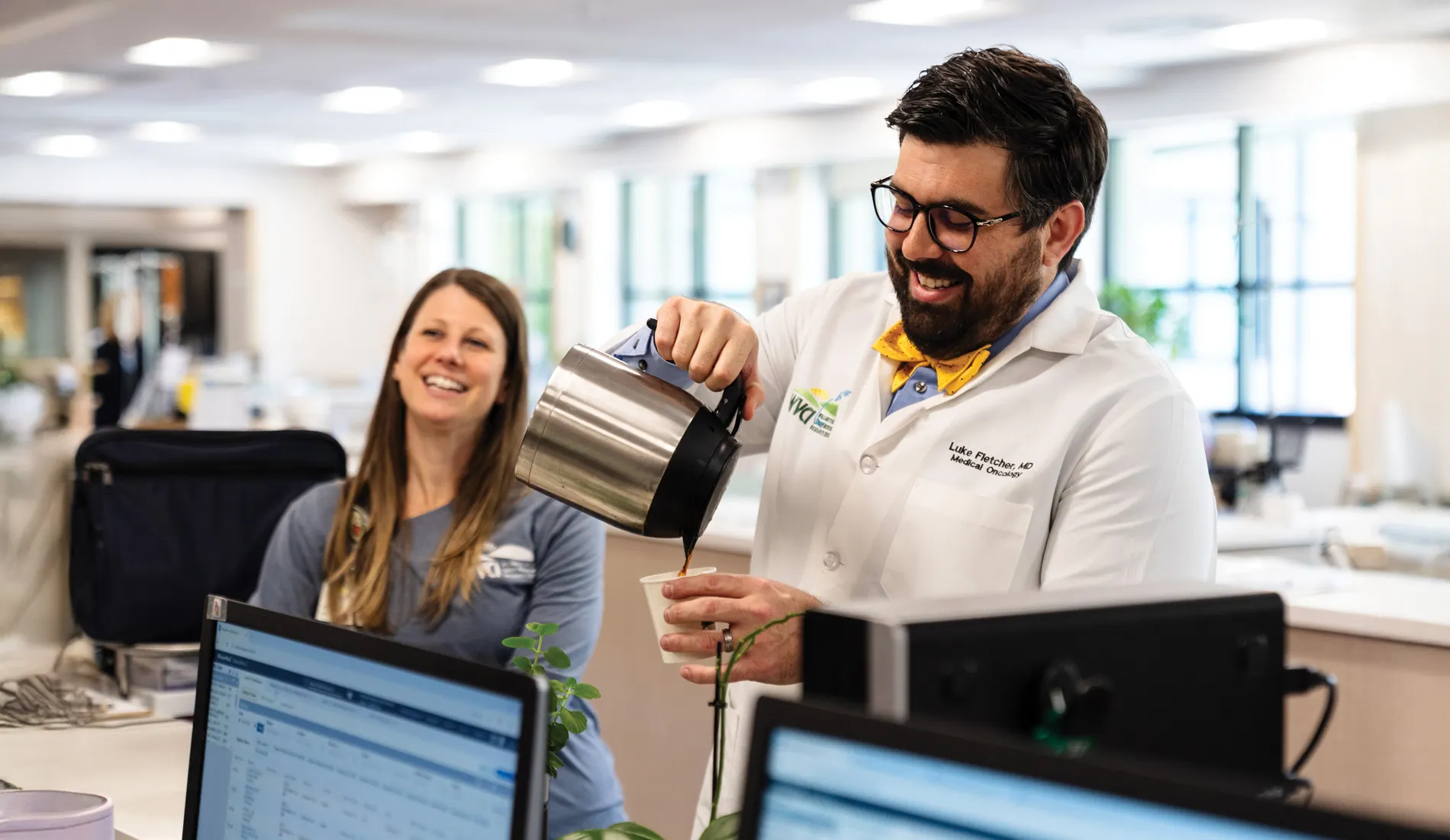
Dr. Luke Fletcher grinds beans, boils water, pours and waits. As the mixture slowly drips through the filter and fills the pot, the rich aroma of fresh coffee fills his office and escapes into the third-floor hallway.
It’s a morning routine for Fletcher, a medical oncologist, hematologist and lab director at Willamette Valley Cancer Institute and Research Center in Eugene, Oregon. But the coffee isn’t just for him. He always makes extra to fill the cups of the nurses, PAs and support staff who work side by side with him each day to care for patients in a community oncology setting.
Perhaps if Fletcher served in a large academic hospital, his office might overlook the city skyline and his assistant might bring him a latte from the Starbucks in the lobby – and there would be nothing wrong with that.
But then who would treat patients in the surrounding rural communities of Cottage Grove, Junction City, or Fletcher’s hometown of Corvallis? Who would speak in Spanish to the family accompanying their mother as she receives treatment? Who would keep the staff caffeinated and their moods elevated with a well-timed joke on a hard day?
No, this is where Fletcher wants to be. It’s where he’s called to be.
“God has blessed us by entrenching us here,” says Fletcher, a 2009 George Fox graduate who lives in Eugene with his wife, George Fox alumna Andrea (Dooley) Fletcher, and their two children. “Being able to provide something that’s not available in a lot of community settings, and to provide care to people in my local community where I grew up, it’s a huge part of my calling.”
A Christian Physician
For Fletcher, every move he’s made along his career journey – from majoring in biology at George Fox to medical school at the Keck School of Medicine at USC, a residency at the Baylor College of Medicine, and a fellowship at Oregon Health & Science University – has begun with a simple question: “OK, God, what do you have for me?”
“I am not a physician who’s a Christian. I am a Christian physician,” he says. “The difference between those is that my core identity is not as a doctor – my core identity is in Christ. The calling comes first and then the career.”
In the career that has followed the calling, Fletcher specializes in blood cancers – including acute leukemias – that affect white blood cells, red blood cells and platelets.
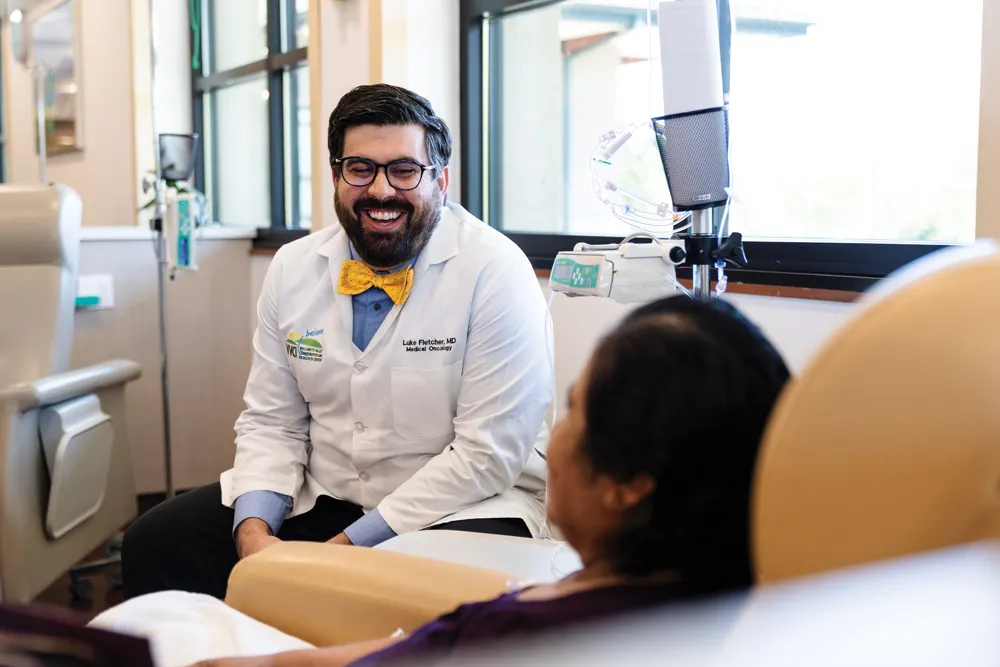
The Best Medicine: Fletcher lifts the spirits of a patient as she receives treatment. “Humor is a big part of my practice,” he says.
“Acute leukemia care tends to be something that’s relatively specialized and done in large academic settings or large hospital systems,” he explains.
But for the past five years, patients in Eugene, his second practice in Corvallis and the surrounding areas have been able to forgo the long drive to Portland and go to Fletcher and his team instead. Connecting with those patients on a personal level is one of his great joys.
“I always want to get to know my patients deeply so I can understand what matters to them,” he says. “I think that allows you to be able to select the best treatments – that’s where the art and the science of medicine really interact. The science of medicine is there’s this treatment for this cancer. The art is how you apply it to your patient.”
To get to the art requires trust – something Fletcher works every day, with every patient, to build.
“I tell my patients, ‘Hey, I’m going to wade into this fight with you. I’m not going anywhere. I care about you and want the best for you, to walk through this with you,’” he says. “Earning that trust – and I’m not saying it’s given – but earning that trust is a huge part of my practice.”
“Being able to provide something that’s not available in a lot of community settings, and to provide care to people in my local community where I grew up, it’s a huge part of my calling.”
So too, surprisingly, is humor. “I joke with my patients,” Fletcher says. “When it’s serious, it’s serious, but humor is a big part of my practice. It’s a big part of dealing with the gamut of emotions that are natural to cancer care.”
And as he continues to mature as a physician, Fletcher has also learned to listen for God’s voice in each moment. “One way I’ve really grown in my role is I’m always looking for opportunities now to not just be a healer in the physical sense, but also in the spiritual sense,” he says. “So if there’s an open door where I feel like God is saying, ‘Hey, pray with that person,’ I’ll do it. It’s something that’s a part of my daily practice and something I’ve grown a lot in, knowing when those opportunities come along.”
Each day, Fletcher comes back to the same question: “Hey God, you’ve called me to this. What do you have for me today?”
Research-Driven
Fletcher’s practice begins with patient care, but it doesn’t end there – far from it. From 8 a.m. to 4:30 p.m. he sees patients. In between and after, his time is devoted to research.
As chair of the leukemia executive committee for a nationwide network of community oncology practices that represent about 15-20% of all cancer patients, Fletcher reviews and helps select clinical trials, monitors patients enrolled in studies, and works to make emerging therapies more accessible to patients just like his.
“We’re starting to better understand cancers,” he says. “Specifically with blood cancers, what are the specific things that are driving those and how best can we target them? Instead of just killing everything, can we target the direct thing that’s causing the cancer cells to grow and then kill it off that way? Especially within the acute myeloid leukemia (AML) world, there are more targeted therapies that continue to come down the pipeline. I think there’s a lot of hope growing.”
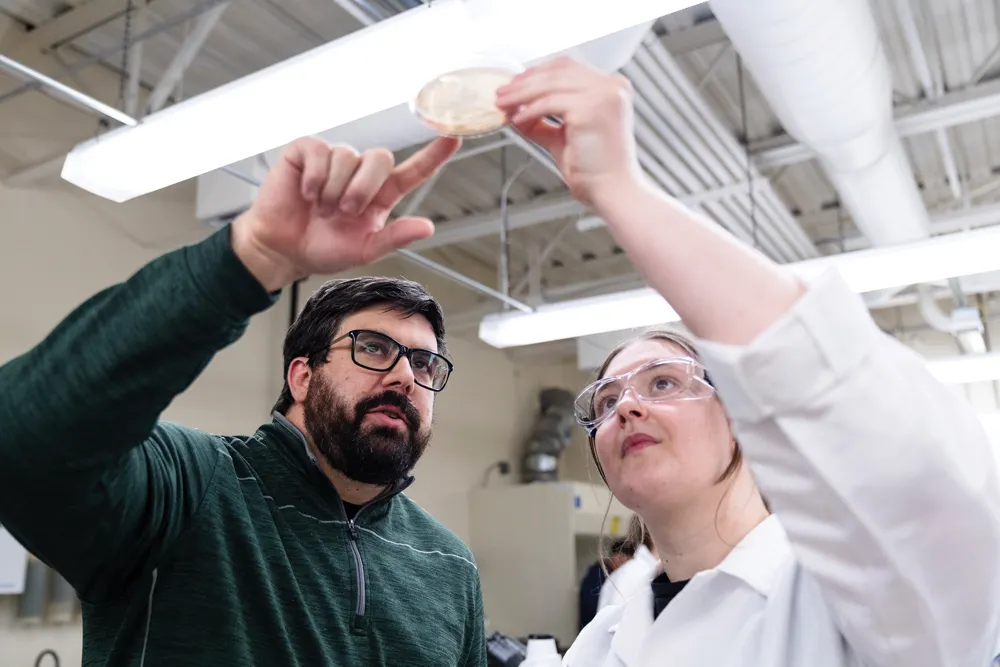
Giving Back: Fletcher mentors senior biology major Paige Hill on a recent visit to campus.
As an oncologist, Fletcher can impact the lives of patients in his local community. As a lab director, his impact is nationwide. In 2025, he coauthored American Society of Hematology guidelines for treating AML in older adults. Published in the journal Blood Advances, those guidelines have been used to shape national standards for patient care.
Fletcher’s love for research began in another small town, Newberg, as a biology student at George Fox. His first year on campus in 2005 coincided with the arrival of biology professor John Schmitt, a noted cancer researcher himself. For more than 20 years, Schmitt has dedicated his summers to researching breast, prostate and bone cancers, utilizing the help of biology and biochemistry majors – a rare opportunity for undergrads. Fletcher was among his first lab assistants.
“My time in the lab with Dr. Schmitt really sparked my interest in research,” he says. “As a freshman, I knew I wanted to do something in the scientific world, and I knew I was pretty interested in the medical world as well. Dr. Schmitt became a mentor and asked,
‘What do you think about research?’ That was my first step from classroom work into research.”
A ‘Hammer Moment’
The journey from college student to oncologist wasn’t always an easy one. After his freshman year, Fletcher, who has Crohn’s disease, developed a serious infection that required emergency surgery.
“I had this surgery, I’m in the hospital for three days, and I remember thinking, ‘God, is this really what you have for me – do you really want me to be a doctor? Maybe I heard wrong. Maybe I need to change my plan, because if this is what my health is going to be, I can’t move forward.’”
It was the first of many times Fletcher would ask this same question: “OK, God, what do you have for me?” Each time, the answer was clear.
“I was blessed that my surgeon was an amazing Christian man,” he recalls. “He said to me, ‘Luke, if you’re called to be a doctor, you need to go for it. This shouldn’t stop you.’ God often speaks in quiet voices, but this was one of those hammer moments.”
Today, Fletcher’s career has come full circle, and he gets to provide the “hammer moments” as a mentor for George Fox pre-med students.
“I left George Fox with fond memories, I left with relationships that were really important to me, but I also left with a desire to give back,” he says.
For Fletcher, who funds a scholarship for pre-med students at George Fox, that means more than just a financial commitment – it means giving of himself, from one-on-one mentoring to opportunities to shadow him at his clinic.
“I tell students, ‘Hey, your journey is going to look different than mine, but these are the things that helped me along the journey, and they may help you,’” he says. “‘These are the important things that sustained my faith when things were hard. This is what I learned about how to rely on my support group better, how to let my wife and kids into my career.’”
And it’s a good bet that Fletcher will share with these students the simple question that has shaped his calling and career for the past 20 years, and will no doubt shape theirs as well: “OK, God, what do you have for me?”
You Might Like:
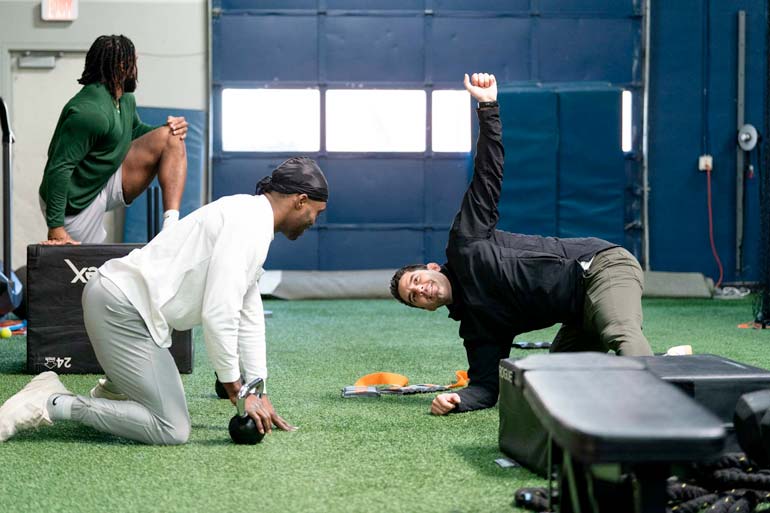
Physical Therapist to the ‘Stars’
Whether he’s working with NFL athletes or a 94-year-old trying to walk without pain, Ryan Baugus treats his physical therapy clients with the same mindset: They are the “star of the show”
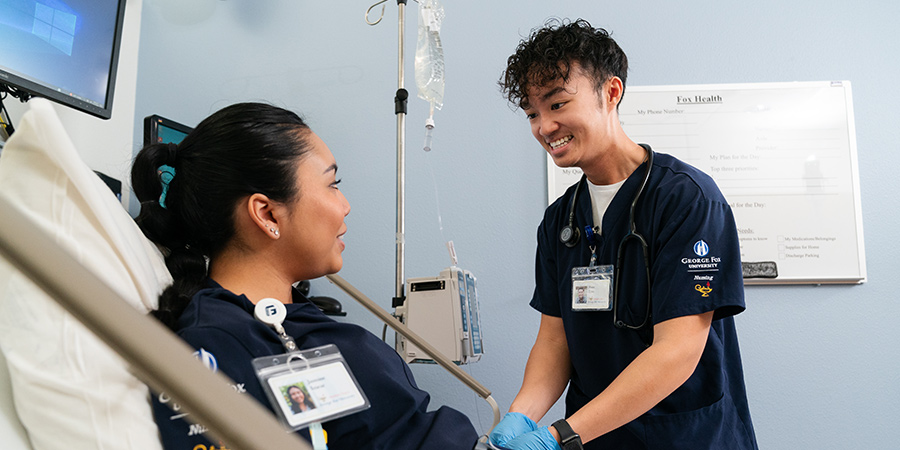
From Cancer Patient to Oncology Nurse: Behind the Bruin
When Peter Tran was a cancer patient at Randall Children’s Hospital, he dreamed of one day returning to help kids just like him in their own battle with cancer. Today, the senior nursing major is doing just that.
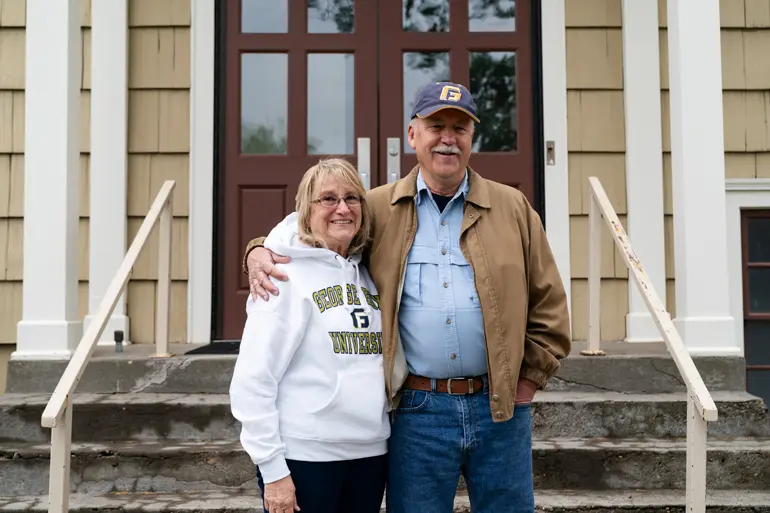
‘Instructions in a Nutshell’
Dave and Debbie Powell returned for a 50-year reunion and left with a renewed sense of purpose and calling in their lives
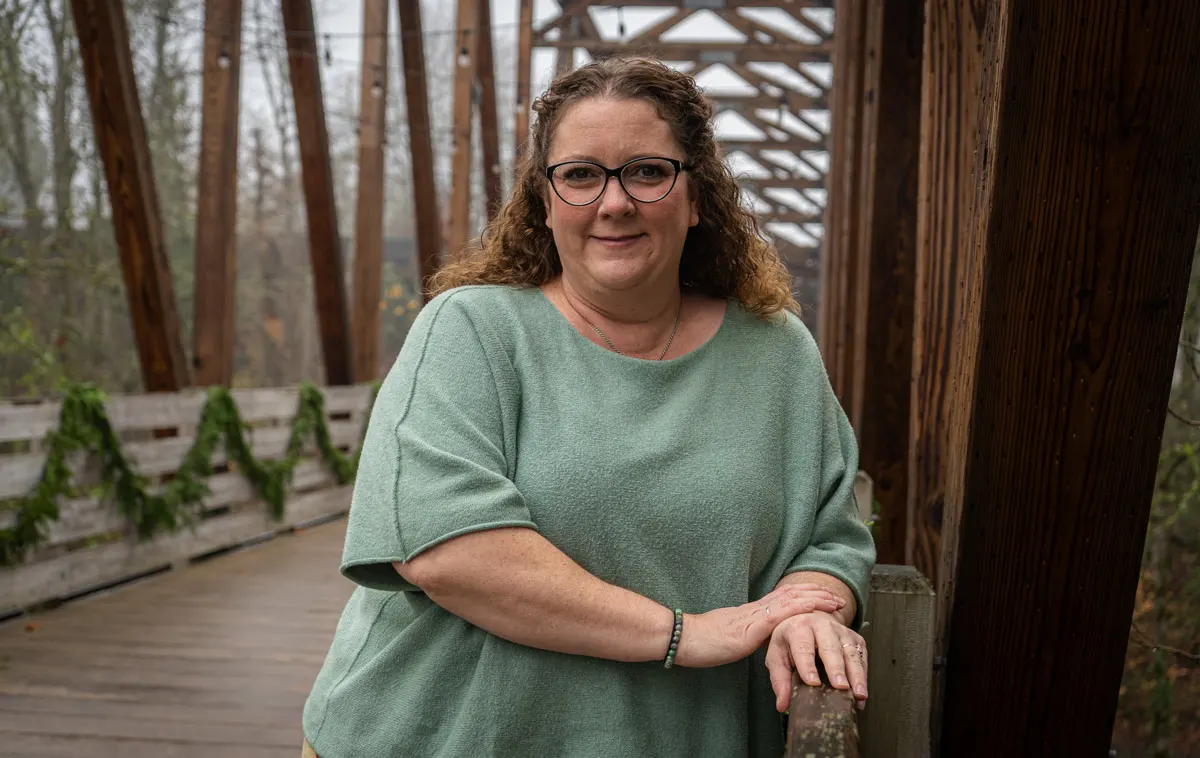
Empowered So She Can Empower Others
Emilia Reynolds discovered a newfound strength in completing her healthcare administration degree online. Now, she faithfully serves others in hospice care.
A Father’s Love
From hospital housekeeper to pediatric nurse, Noriel Sanchez’s ongoing journey to care for his son put him in a position to help other kids as well
‘Here is Water’
A professor and three students chose to answer God’s call, turning an engineering class into an impromptu baptism
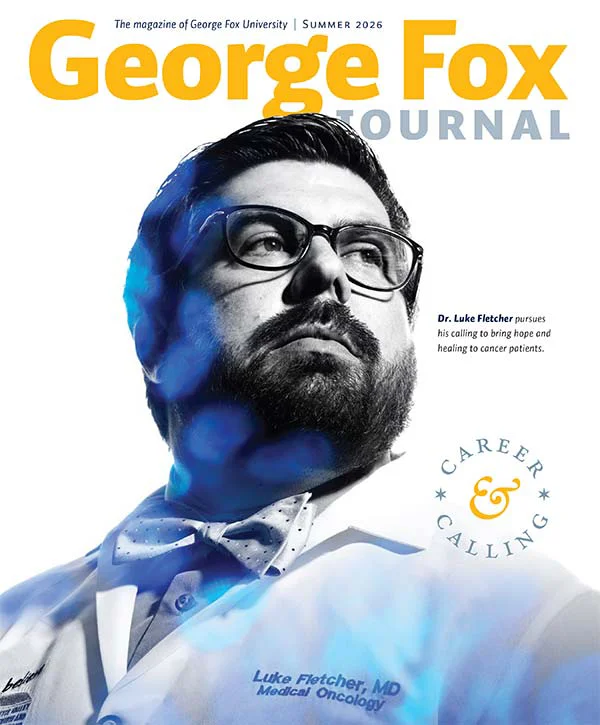
Cover of Summer 2026 issue
Looking for more?
Browse this issue of the George Fox Journal to read more of the stories of George Fox University, Oregon's premier Christian university.