

A Different Brand of Courage
stories of Faith, Grit and Joy
Two percent of people with Apert syndrome attend college, but Sam Poukish isn’t one to be defined by the odds
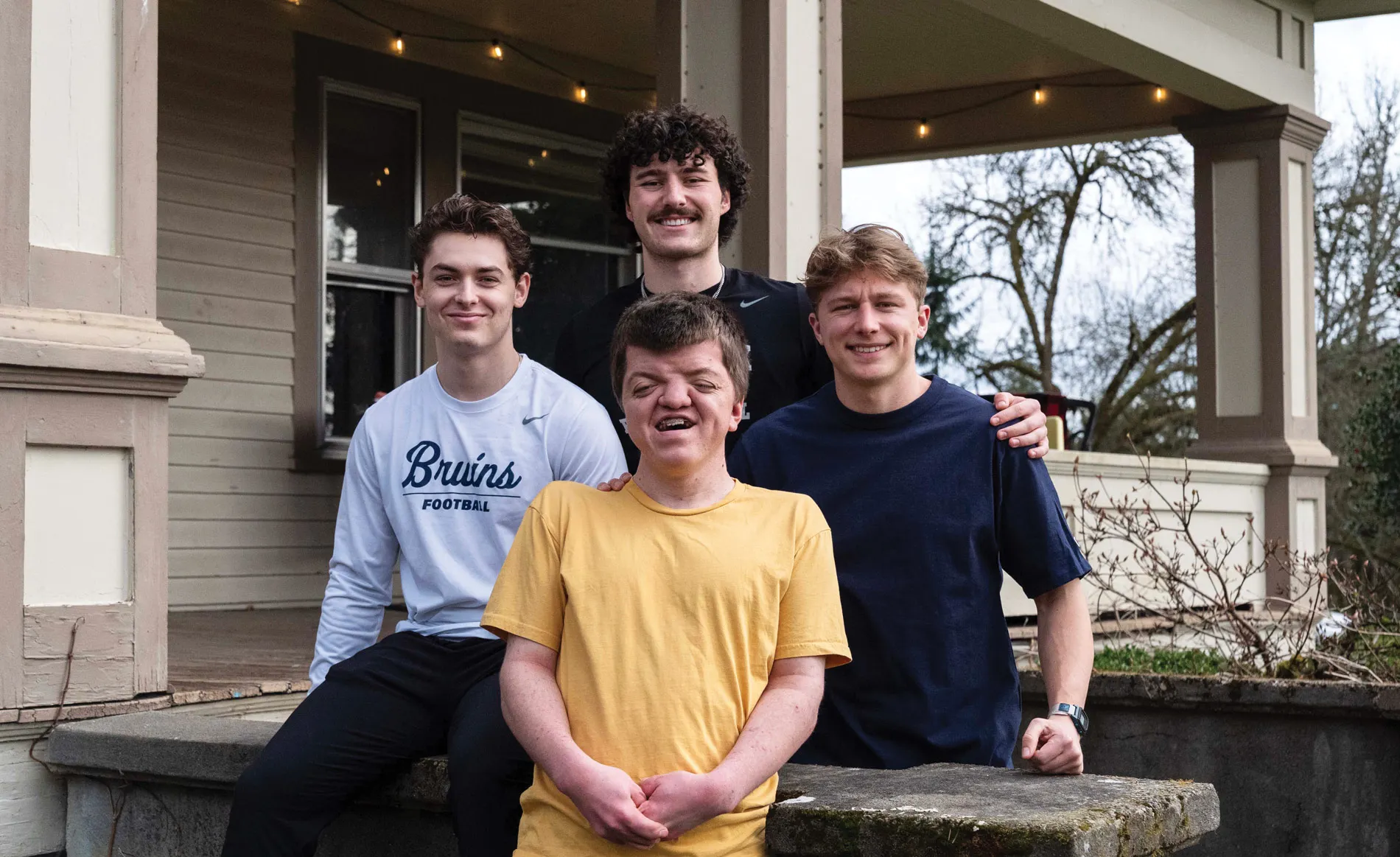
The key wasn’t anywhere. Sam Poukish double-checked his backpack, then sat on the worn front porch of the old craftsman house he shares with 12 other students at George Fox. Eventually someone would come along and let him in. He could text a housemate but didn’t want to be a bother. He could be patient.
Sam is forced, more than most people, into patience. He can’t tie his shoes, knot his tie, fix his collar or button his buttons. Keys are difficult to maneuver. Damaged optic nerves and eyes not aligned mar his depth perception. He will never drive a car.
This is Apert syndrome, where the skull fuses too soon before birth, affecting the eyes, ears, teeth and brain. Fingers are webbed. Sam was 3 months old during his first surgery, which released pressure on his brain. That was followed by two more cranial surgeries, six surgeries to separate his fingers, and spinal surgery. He logged 13 surgeries total, not counting adenoid, ear and dental procedures.
Building Bridges
But the guys in his house aren’t letting his story stop there. And Sam is determined to live his story to the fullest – while increasing his housemates’ vocabulary.
“Whenever he asks how workouts are, I usually say, ‘Fine,’” says his roommate, sophomore Gage Gibson. “I don’t like communicating. He’s like, ‘All right, we’re going to try and use a different word than ‘fine’ this time.’”
The house is part of The Bridge Network, an on-campus mentoring and training program for student leaders. Community and accountability are part of the deal, and personal growth is non-negotiable.
“He’s always the first person to ask us about our day and how we feel,” says housemate Sam Astor, a junior. “Or he’ll ask us a question, and I’m like, ‘I’ve never been asked that before.’”
Sam thrives in community, whether through Bible studies, meals together or weeks-long stealth water gun wars. But personal growth is painful for everyone.
“Sam loves to share everything he’s gone through,” says housemate Mason McBride, a senior. “But it was to a point where I said, ‘You are not Apert syndrome. That is a struggle you have, but how is God going to use that to bring him glory, and how are you going to walk into that?’”
Sam is leaning further into the identity his housemates insist on for themselves and for him. “You’re defined as a child of God,” Gage says, “and that identity is not based on anything of this world, but it’s based on the mercy given to us.”
What Sam wanted was to be like everyone else, or maybe even like the celebrated few.
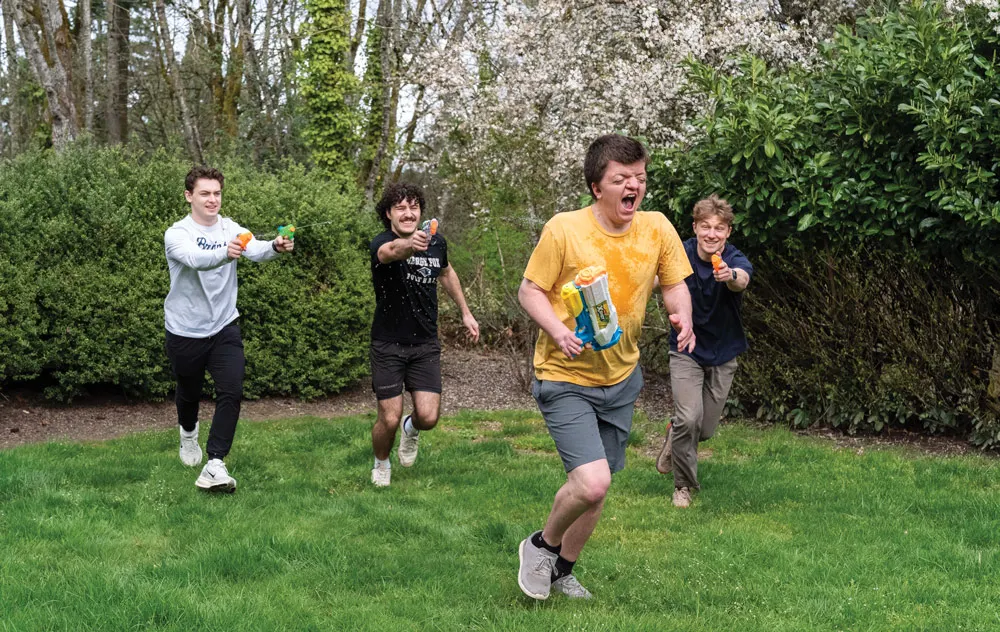
Sam and his housemates (from left to right) Mason McBride, Gage Gibson and Stewart Johnson engage in one of his favorite activities: a water gun fight.
“Growing up, I really wanted to be a superstar athlete,” he says. “I watched YouTube videos of locker rooms and thought it was the coolest thing ever. I wanted to be a basketball player, a football player.”
But in the ninth grade, Sam wasn’t trying out for football – he was pushing against tremendous pain after spinal surgery, walking again in record time. He became a skilled tennis player in high school. In college, he is a worthy opponent in pickleball and golf.
His housemates say he runs like the wind. He also giggles like a 10-year-old when he pulls out his water gun, preparing to eliminate one more person from the secret water battle that rages between classes.
Living the 2 Percent
Physical limitations will always influence Sam’s life. He needs rides to the store. He doesn’t see that the pot he’s scrubbing isn’t clean. While Sam has dialed back his defensiveness over housekeeping corrections, the guys have allowed his story to influence theirs.
“Walking with him teaches us to serve, to put ourselves in others’ shoes,” Mason says. “Sam is inspiring because he presents a lot of unique challenges physically. People with far fewer challenges crumble. Sam doesn’t crumble. He just puts a smile on and goes about his day. He’s taught us so much about servanthood, brotherhood and love for each other.”
“Sam is inspiring because he presents a lot of unique challenges physically. People with far fewer challenges crumble. Sam doesn’t crumble. He just puts a smile on and goes about his day. He’s taught us so much about servanthood, brotherhood and love for each other.”
Craig Inglesby, director of The Bridge Network, sees Apert syndrome as an access point, not an excuse. “I have limitations, you just can’t see them,” he says. “Sam’s are visible. I say to Sam, ‘You’re a qualified guide in this arena of people where your voice is 1,000 times more effective than mine. Are you going to use it?’”
While he’s figuring out the long-term, Sam is speaking into his friends’ lives every morning. In 30-second video clips, he is a coach, cheerleader and pastor. He may pray for his friends or just say it’s going to be a good day. A new video each day, sent to everyone’s phones.
One morning, after studying most of the night at the library, Mason got his video. “I’m stressed out of my mind,” he recalls. “The exam could literally fail my class. Sam sends his little morning video: ‘Let’s go! Great morning to be a Bruin!’ That felt pretty good. And I sent a text back, ‘Thank God – I almost thought it was going to be a bad day today.’ It’s a fun little back-and-forth we get to have.”
One study shows that 2 percent of people with Apert syndrome attend college. Sam, now a senior, is ignoring the odds and forging his own path.
“When I was young, it was hard,” he admits. “A lot of rocky roads with the surgeries, name-calling, bullying. But there’s a light at the end of the tunnel. There’s just a lot of people who are there for you, and they’re in your corner.”
Patience, teamwork and ingenuity are qualities most people aspire to. For Sam, they are a necessity. Sometimes, though, he gets tired of asking for help. That’s when he chooses to wait – perhaps on the worn porch of his own house – and notice the good around him. “When you can’t find the sunshine, be the sunshine,” he says. And then he tries to live it.
You Might Like:
The Roads Not Taken
Faculty members Stanley Paul, Trevor St. Clair and Kate Turner didn’t set out to be occupational therapists, but they ultimately couldn’t shake the appeal of the profession
A Way Out, A Way Forward
After years of homelessness and addiction, Tia Renner found sobriety, purpose and an unexpected path to law school, pursuing her dream to become a voice for others
Get Involved: Fostering Community at George Fox Through Student Groups
How to get involved in a variety of student groups on campus
‘God is always going to be there’
It was 2019 and Anthony Pasion was living his dream playing college football. Then a sophomore defensive lineman on the George Fox football team, he earned All-Northwest Conference Second-Team honors and was coming into his own not only as a player but as a person.
Psychiatric Mental Health Nurse Practitioner Program to Launch in 2027
George Fox will launch a new program in response to a growing mental health crisis in the Pacific Northwest
A Sacred Space
The university’s new chapel invites students to worship and grow closer to God in new ways
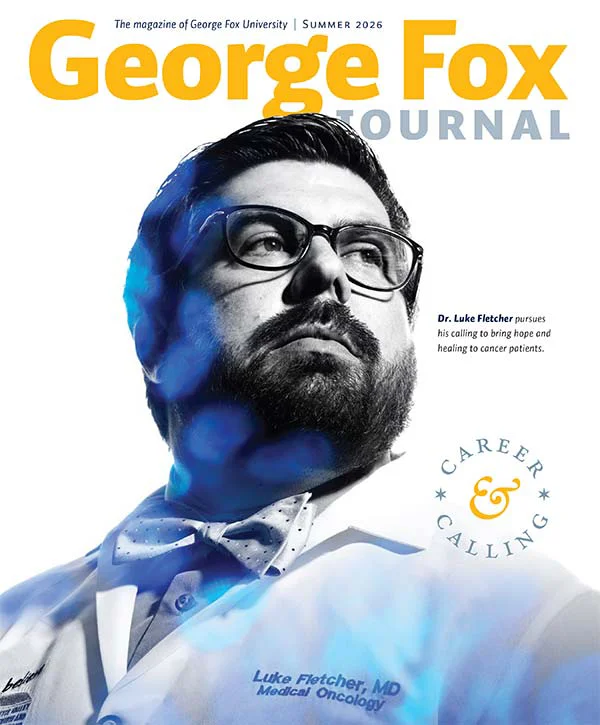
Cover of Summer 2026 issue
Looking for more?
Browse this issue of the George Fox Journal to read more of the stories of George Fox University, Oregon's premier Christian university.