
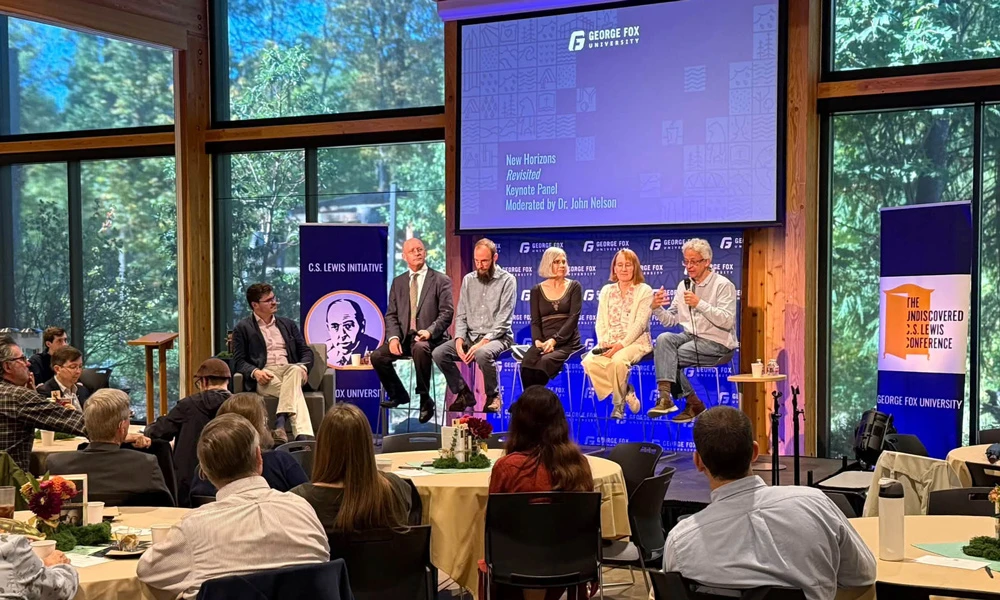
The 2026 Undiscovered C.S. Lewis Conference
Scholarship and collegial camaraderie abound at the world’s largest recurring academic C.S. Lewis Conference
by Jaime Handley
If there’s one household name in the world of Christian fiction and thought, it is the author of the beloved Narnia series and deeply poignant books like Mere Christianity and The Great Divorce. Say the name “C.S. Lewis” at a small group gathering or book club and almost every head will nod in recognition, no matter the denominational affiliation or, even more unusual, the stage of life.
For many of us, the Chronicles of Narnia was our introduction to C.S. Lewis as an author. But for C.S. Lewis students, scholars, and fans, there is a whole world of research to behold and discover well beyond Lewis’s more well-known writings.
Cue George Fox’s 2026 Undiscovered C.S. Lewis Conference, presented by the C.S. Lewis Initiative. With a word like “undiscovered” in the title, you know this isn’t your run-of-the-mill academic gathering, proving that there are still discoveries to be made around the life and writings of this treasured author.
For that reason, under the direction of Dr. Jason Lepojärvi and with the assistance of the planning team – Dr. Gary Tandy and Twila Lamar – George Fox hosted the second Undiscovered C.S. Lewis Conference. The largest of its kind in the world, the conference brought together over 260 attendees from around the globe — with many more joining virtually—in an environment that represented the best of Lewis’s own timeless values – rigor, warmth, the rational, and the imaginative – all in one energizing weekend that gave voice to the finest C.S. Lewis scholars of our time.
Dr. Gary Tandy, emeritus professor of English at George Fox, describes the Undiscovered C.S. Lewis Conference as a place designed to be inclusive and welcoming to both academic scholars and general C.S. Lewis enthusiasts.
“People who are just interested in Lewis and like to read and discuss his work are all invited. You’ll find that some conference presenters aren’t necessarily from an academic background,” Tandy says. “They’re just people – maybe accountants or engineers – but they do this on the side because they simply love Lewis.”
And he reminds other enthusiasts that while much scholarship has been done on Lewis since his death in 1963, much remains to be explored.
Tandy says, “As one example, there are three volumes of letters from C.S. Lewis that are published, but we know that there are maybe 1,000 more letters out there that have yet to be published. And so, original research is still very much happening!”
In fact, Tandy shares, new poems are still being discovered in strange places, like the flyleaf of one of Lewis’s books. The world of Lewis scholarship, in many ways, is just getting started, and the Undiscovered Conference seeks to be a leading force in that groundswell.
The Next Generation of Lewis Scholars
Part of the movement toward new discoveries is the invitation for up-and-coming Lewis scholars to submit papers to the conference. One of these young scholars is George Fox senior Colton Kirby, a theology and philosophy major in the honors program, C.S. Lewis intern, and inaugural president of the Lewis & Tolkien Student Society.
Kirby, who presented at the first Undiscovered C.S. Lewis Conference in 2024, had the opportunity to present again and shared his paper “Augustinian Illumination and C.S. Lewis's Theory of Imagination,” in which he argues that Lewis uses stories and imagination to help us understand deeper truths, much like Augustine believed that God reveals truth by illuminating our minds.
Dr. Tandy reflects that the beauty of the C.S. Lewis community lies in its generosity and desire to connect with younger scholars.
“Older scholars want to help the next generation and give them the benefit of their experience. It’s a very healthy atmosphere and one that’s non-intimidating,” Tandy shares.
To have his paper accepted for presentation at the conference, Kirby wrote a brief abstract, which then went through a double-blind review process, meaning both the reviewers and the presenter remained anonymous throughout the review to ensure the integrity of the work. Five different reviewers – esteemed international scholars in their fields – read the proposals. Once Kirby’s proposal was accepted, his deeper research process began – research that took him into Lewis's life, mind and writing before his conversion to Christianity.
As Kirby reflects, “Lewis is always changing. There’s not only one stage of pre-conversion. There are multiple stages, which makes things more complicated.”
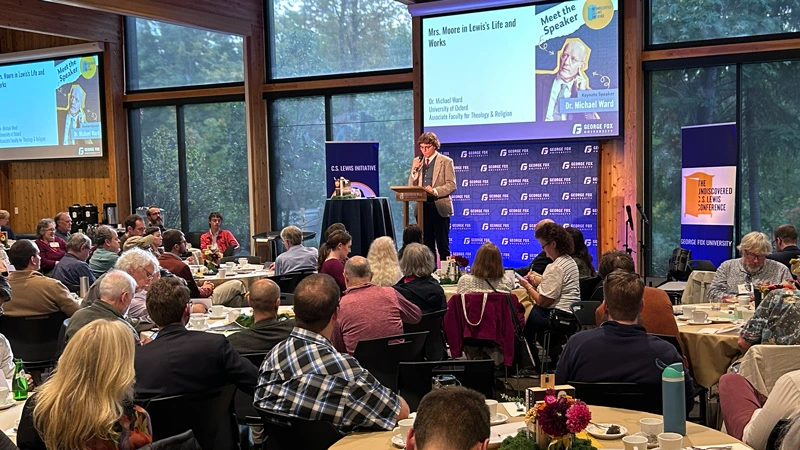
Introduction for keynote speaker Dr. Michael Ward
Whereas Kirby’s first paper was accepted immediately for the 2024 conference, his second proposal was initially sent to resubmission. But the hard work paid off when he was accepted in the second round.
His paper explored C.S. Lewis’s view of imagination as the faculty by which we access stories, in relation to Augustine’s views. “I think it was received positively,” Kirby says. “I got some good feedback on looping Plato into the conversation more deeply.”
As a student in the George Fox honors program, Kirby has had multiple opportunities to present his work. He won the best undergraduate paper competition (first place) for the Pacific Northwest American Academy for Religion conference twice, once in 2025 and then again in 2026. He’s also presented twice at George Fox University’s Eclectic Texts Conference and will soon submit a proposal for that upcoming conference.
Impressively, Kirby was also recently nominated for the prestigious Barry Scholarship, which offers a full ride to Oxford University, including full funding for tuition, a living stipend, and a yearly research and travel allowance. This highly competitive scholarship, with a rigorous application process, has been awarded to two previous George Fox Honors Program students.
The honors program at George Fox is a chronological great books experience where students learn from classical texts under the guidance of professors. Kirby’s presentation at the 2024 Undiscovered Conference was inspired by a class he took with Dr. Lepojärvi as a freshman.
“Jason taught a class on C.S. Lewis and love based on his dissertation, and I focused on love of animals and Lewis’s theodicy of animal suffering, which I presented at the first Undiscovered C.S. Lewis Conference in 2024.”
Kirby, now a senior looking toward his future, is applying to graduate programs in philosophy and theology, including Notre Dame, Duke, Boston College and Yale, among others.
He noted the level of engagement and participation at the conference, as well as his own joy in connecting with Lewis student scholars from around the country, as he looks to the future as a post-graduate.
“I was able to connect with two current PhD students in philosophy from Baylor,” he shares. “This was probably the high point of the conference for me.”
What Makes the Undiscovered C.S. Lewis Conference Unique?
The beauty of the Undiscovered C.S. Lewis Conference lies not only in the academic rigor and scholarly connections, but also in its appeal to both younger and older Lewis fans.
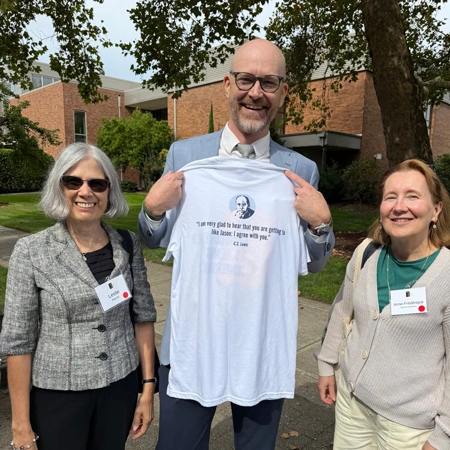
Conference attendees with a C.S. Lewis themed shirt
As Kirby explains, “I think there’s a general sense in my generation of being overwhelmed with the developments in technology. What Lewis is doing to one degree or another is bringing mythology and elements from times past and re-encapsulating these myths in various ways in his fictional works. Young people seem to understand that there’s something valuable there that our culture sometimes overlooks.”
Dr. Tandy notes that Lewis’s personal journey from atheism to Christianity and his approach to faith through imagination and metaphor appeal to readers looking for an intellectually satisfying faith. He elaborates, saying, “Lewis’s own personal story is captivating for young people. The fact that even though he was raised in the church, he turned his back on religion in his early teens and didn’t come back to proclaiming faith until his early thirties intrigues people.”
As well, Lewis’s unique way of explaining the Christian faith understandably, sans preaching, but rather through engaging the imagination, draws in a generation hungry for thoughtful faith engagement.
Reflecting on his own C.S. Lewis discoveries, Dr. Tandy shares: “When I was in my high school years and disillusioned with the church, Lewis gave me a model of a thinking person and how they would look at faith and be rational and intellectual while still very engaged.”
New Scholarship in a New Era
Lewis’s work continues to inspire and draw collaboration from those engaged in theology, philosophy, and the study of the imagination.
The ongoing body of scholarly work represented at the Undiscovered C.S. Lewis Conference touched on topics from restorative dominion and science as apologetics to the Inklings on abortion and new digital tools for Lewis scholars.
As well, the conference hosted two theatrical performances: The Fire and the Rose: T.S. Eliot and C.S. Lewis in Conversation – a play highlighting the relationship between Lewis and Eliot – and Leaf by Niggle, a one-man show that framed Tolkien’s text with personal storytelling to portray the story’s significance for artists, scholars and communities.
There was also a bonus event: an opportunity to view parts of an upcoming documentary series called The Forge of Friendship, about the friendship of Lewis and Tolkien.
Each of these conference opportunities led to a richer understanding of C.S. Lewis's impact on our current modes of thinking about the power of story, philosophical forms, and apologetics.
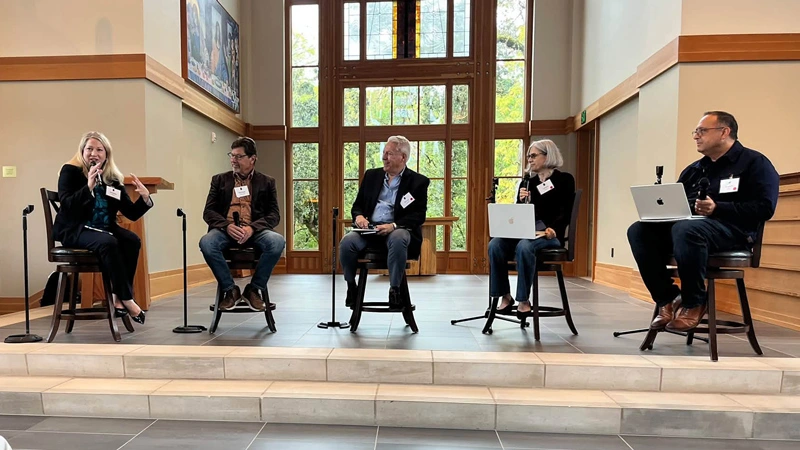
Workshop taking place in the George Fox chapel
Dr. Tandy highlights the number of returning conference attendees and keynote speakers from the 2024 conference, such as Dr. Steve Beebe and Dr. Jahdiel Perez, who, though not presenting this year, returned to participate in the conference, underscoring the event's collegial camaraderie. He himself experienced this camaraderie directly when one of the keynote speakers, Dr. Michael Ward, a leading scholar on C.S. Lewis and the Inklings, recognized his research from the stage.
Dr. Tandy says, “When asked in the final panel discussion to name something he heard at the conference that represented new and promising research in Lewis studies, Dr. Ward shouted out my work on Samuel Johnson’s influence on C.S. Lewis.”
Kirby also experienced the joy of the scholarly community, as one paper in his panel session focused on Lewis's marginalia of Athanasius of Alexandria's On the Incarnation, which directly tied to his own research.
He shares, “This was really fascinating, and I also learned that Lewis has extensive marginalia of Augustine of Hippo's Confessions and City of God. As my own presentation was on Augustine, this opened in my mind a fruitful place for future research.”
Kirby also noted the draw from the Lewis community, which was a good mix of academics and regulars – with much of the work by "regulars" being serious, passionate and interesting.
“There’s a lot of engagement at this conference,” he reflects. “No one wants to present to an empty room, even at a really nice conference. That’s definitely not the case here. There’s a general lack of pretense and a true, genuine love for the research. And the research is incredibly wide, because Lewis himself is incredibly wide. It diversifies the specialization.”
Dr. Tandy agrees. “It seemed like everyone was comfortable not just being an observer but an active participant in a community. The opportunity to have conversations with so many Lewis and Inklings scholars and enthusiasts in person was priceless.”
As they look to the future, both Dr. Tandy and Kirby see the possibility of expanding scholarship opportunities.
The 2024 Undiscovered Conference proceedings were recently shared in Sehnsucht: The C.S. Lewis Journal, which George Fox now publishes.
The conference also helped host the first Catholic Mass in the new chapel, which Kirby would love to see happen again, saying, “I think this leaned into the ecumenical side of Lewis and of George Fox University.”
And so, as the 2026 Undiscovered C.S. Lewis Conference wraps up, there is hope for future discoveries in Lewis scholarship. With plans for the 2028 conference already underway, opportunities abound to rediscover this renowned literary giant.

Related Posts

The Future Is Bright for George Fox Pre-Meds
How a new agreement with A.T. Still University gives students an inside track to pursuing their dream and potentially solve a doctor shortage

Student Hacks: How to Take Advantage of Online Courses at Fox
Seasoned students share what makes Fox’s online classes great – and why you should give them a shot, too

Science Outreach Scholarship Honors Longtime Professor
Dwight Kimberly downplays his role in the success of the university’s Science Outreach Program, but a scholarship in his name will ensure it continues to thrive

The Great Books and Homeschooling: Literature-Based Homeschool Curriculum for High Schoolers
Literature-based homeschooling is exactly what it sounds like: an educational model that is primarily structured around reading. How does it work?
Nathan Higa: Restoring Inner Peace
When I met with Nathan Higa at a coffee shop in downtown Newberg, I was greeted with a wide smile and a calming presence. He was incredibly easy to talk to, and I could immediately tell why he was called to complete his doctorate in clinical psychology (PsyD).
Opening Doors to ‘Big Ideas’
Through George Fox University’s Liberation Scholars program, Latino/a students attend a free, two-week seminar to expand their knowledge, chart their future, and equip themselves to be leaders and difference makers in their communities.