Tibet & Nepal
Faculty: Carlisle Chambers, Jeff Vargason
Class Meeting Time: Tuesdays, 6:30 - 9:00 p.m.
Trip Dates: May 2027
Cost: $2,400
Highlights
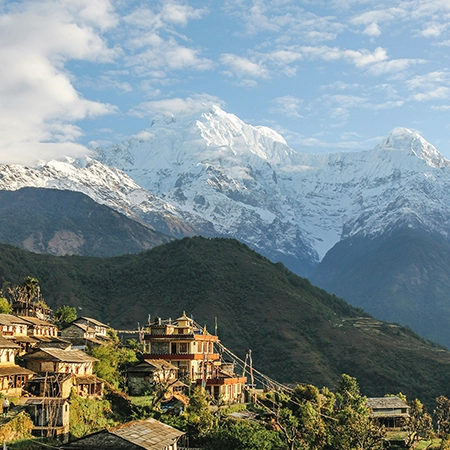
This proposed Junior’s Abroad trip centers on the nature, culture, and religion of the Himalayan regions of Tibet and Nepal. This area is at the center of the world’s highest peaks, has long served as crossroads for trade, pilgrimage, and spiritual practice. During our travels we will experience the predominate religions of Buddhism in Tibet and Hinduism in Nepal that have shaped the daily life of these people for centuries.
We will visit the sacred city of Lhasa, which is home to Potala Palace, the residence of the Dalai Lama until 1959 when he fled to India because of a failed uprising against Chinese rule. We will also explore the temples and stupas of Kathmandu. Our journey between these two cities will take us into the breathtaking landscapes of the Himalayas, including trekking in the foothills of the northern Everest Base Camp at 16,900 feet (5,150 meters) above sea level. Along the way, we will have an opportunity to engage with the locals and culture in these communities.
In addition to examining the religious traditions and cultural dimensions of the region, this program has several larger academic goals. The first is to investigate the relationship between geography, environment, and human culture in high-altitude societies. The people of Lhasa and surrounding communities (11,995 feet) spend their lives above the altitude of Mt. Hood (11,249 feet). The second is to analyze the environmental and cultural impacts of tourism, development, and global connectivity in Nepal and Tibet.
Ten of the fourteen highest mountains in the world including the highest, Mount Everest, are found in the Himalayas and draw many climbers and associated tourists to the region. The third goal is focused on the historical struggles between Tibet and China. While a powerful Tibetan Empire existed centuries ago, China has historically claimed sovereignty over the region, especially since the Mongol-led Yuan Dynasty. During this period, the Tibetan Empire collapsed and was conquered by the Mongols. Today, Tibet is known as the Tibet Autonomous Region (TAR) within the People’s Republic of China (PRC).
NOTE: This is an adventurous Juniors Abroad trip that will include some long days of travel, hiking, and camping at high altitude. Participants must be in good physical shape and be willing to deal with primitive accommodations and conditions.
Tentative Itinerary
| Day | Tentative Itinerary |
|---|---|
| Day 1 | Travel Portland to Beijing, China |
| Day 2 | Travel Beijing (200 feet) to Xining, China; Train from Xining (7,464 feet) to Lhasa (11,995 feet, 20 hour train elevation acclimation) |
| Day 3 | Continue train from Xining to Lhasa |
| Day 4 | Lhasa: Drepung Monastery and Sera Monastery |
| Day 5 | Lhasa: Potala Palace, Jokhang Temple, Barkhor Street |
| Day 6 | Shigatse: Korola Glacier, Shigatse Fortress |
| Day 7 | Xegar/Shekar: Chomolungma Nature Reserve |
| Day 8 | Everest Base Camp: Gyatsola/Gawulu Pass, tent camping at EBC |
| Day 9 | Gyirong Border: Rongbuk Monastery, Pelku Tso Lake |
| Day 10 | Kathmandu, Nepal: Durbar Square, Swayambhunath Stupa |
| Day 11 | Pokhara: Patale Chango (Devi’s/Hell’s Falls), Mahendra Cave, Seti Gandaki Gorge, Old Bazaar, Binhyabasini Mandir |
| Day 12 | Pokhara: Hike to World Peace Pagoda, Mountain Museum and Gurka Museum |
| Day 13 | Dhampus: drive to Sarangkot, trek to Naudanda, Ghatte Khola, and Dhampus |
| Day 14 | Trek to Phedi; return to Pokhara |
| Day 15 | Chitwan: Chitwan National Park, elephant back safari |
| Day 16 | Chitwan: jeep safari, boat ride down Narayani River, overnight at Temple Tiger Green Jungle Resort, cultural Tharu dance program |
| Day 17 | Travel Chitwan to Kathmandu: Asan Bazaar, Thamel, Bishal Bazaa |
| Day 18 | Travel to Beijing, China |
| Day 19 | Return to US |