There’s beauty in directing a film that inspires change, power in producing sound that pulls at someone’s heart strings, pride in creating animation that sparks joy.
If you’re passionate about film and its potential to have impact, join the cinematic arts community as we pursue that shared passion through hands-on projects that develop creative skills.
The cinematic arts major teaches you to merge critical thinking, film theory, and imagination into production. Students choose from three concentrations that prepare them for a wide variety of jobs, ranging from commercial filmmaking to recording rock bands, from crafting 3D animation and special effects to shooting documentaries in third-world countries.
Faith inspires us to be great filmmakers, to be directors, producers and editors who tell the truth and challenge the status quo. It guides us to create with integrity, humility and joy. And faith brings us together as a community – one where professors know you by name and take your passions and ambitions seriously.
George Fox cinematic arts students travel to the Sundance Film Festival in Park City, Utah, to screen films and learn about contemporary independent filmmaking from some of the world's top industry artists and experts. While at Sundance, students also participate in events such as the Windrider Forum, an event organized by Fuller Theological Seminary that integrates themes and questions of faith with film.
Learn to shape stories that inspire, inform and entertain through the art of visual storytelling, our culture’s most powerful medium. Students in the film and video production concentration learn to write, shoot, direct and edit their own films in a way that meets the artistic expectation audiences expect, but also pushes the boundaries of film towards the next big ideas.
Animation is everywhere. Industries that utilize animation range from film and TV to advertising, gaming, motion graphics, scientific visualization, and so much more. Students in the animation concentration get to use industry-standard software to bring their animated stories to life.
Learn every aspect of game design, ranging from programming, art/animation, and writing for interactive experiences, in our interactive media and game design concentration. You’ll learn how to create art – including storyboarding and concept design, 2D computer animation, 3D computer animation, and video game animation – expanding your artistic skills through drawing and digital tools.
Sundance Film Festival with Cinematic Arts Students | George Fox University
Program Distinctives Why Study Cinematic Arts at George Fox?
You’ll be surrounded by a community that shares your passion for storytelling and impact through film. These are people who won’t settle for less than their best, as students and as Jesus-followers, and who will push you to do the same.
You will learn from industry experts who have experience in the field.
There are so many different paths to pursue in the film industry, and that can feel overwhelming. Here, you’ll be exposed to different aspects of the industry, giving you the interdisciplinary knowledge of different areas of film to back up your specialty.
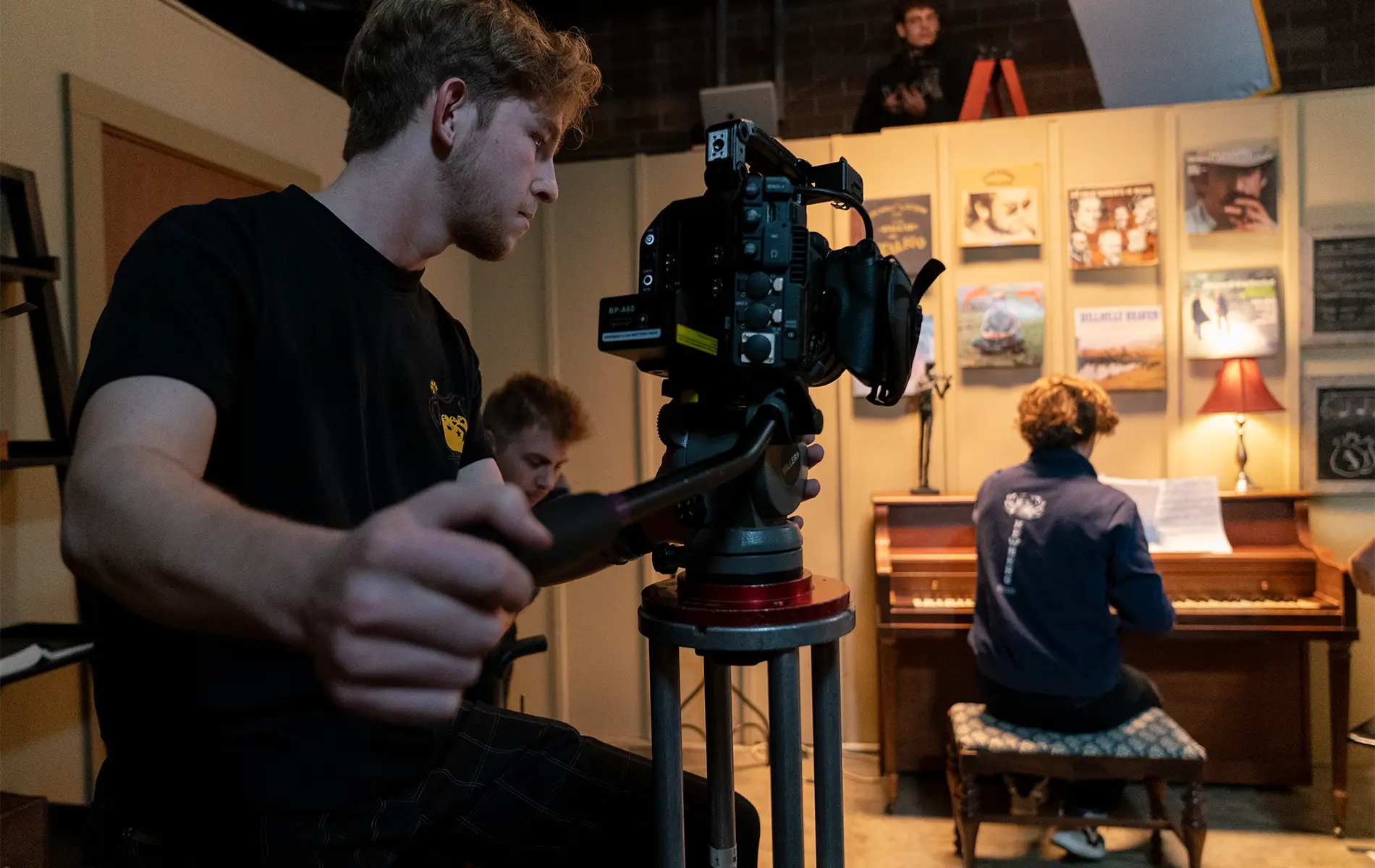
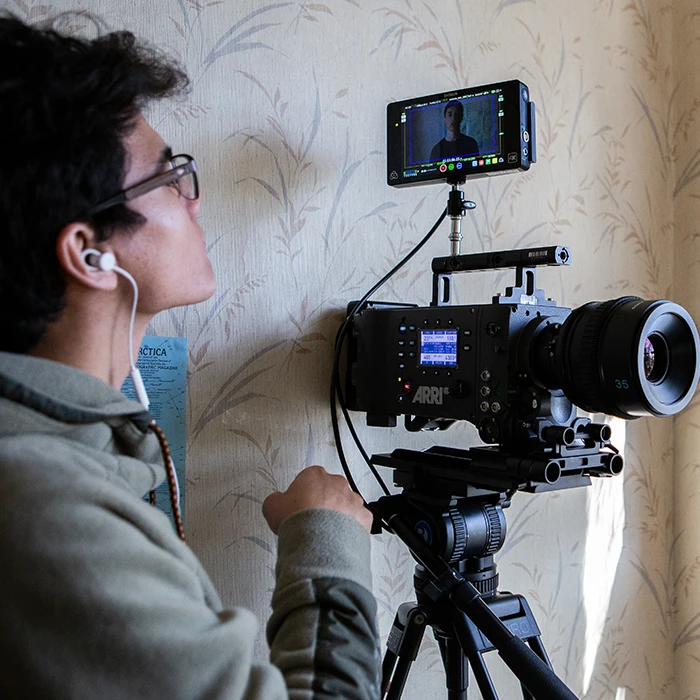
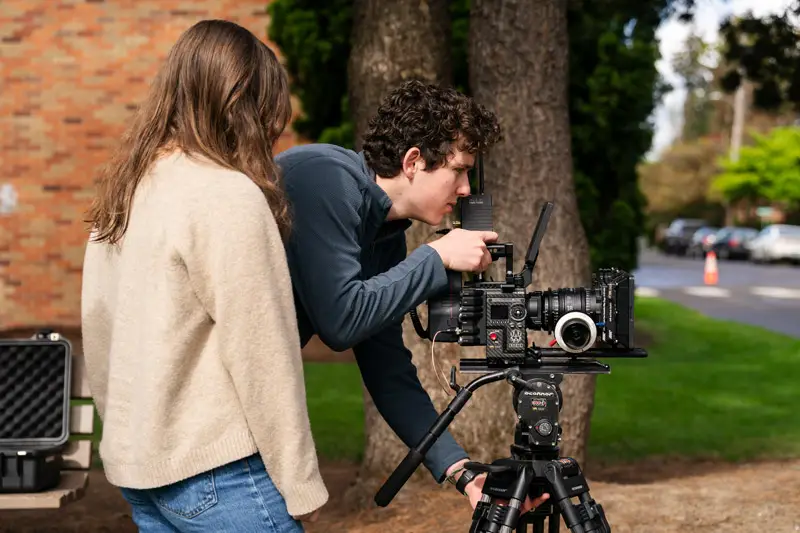
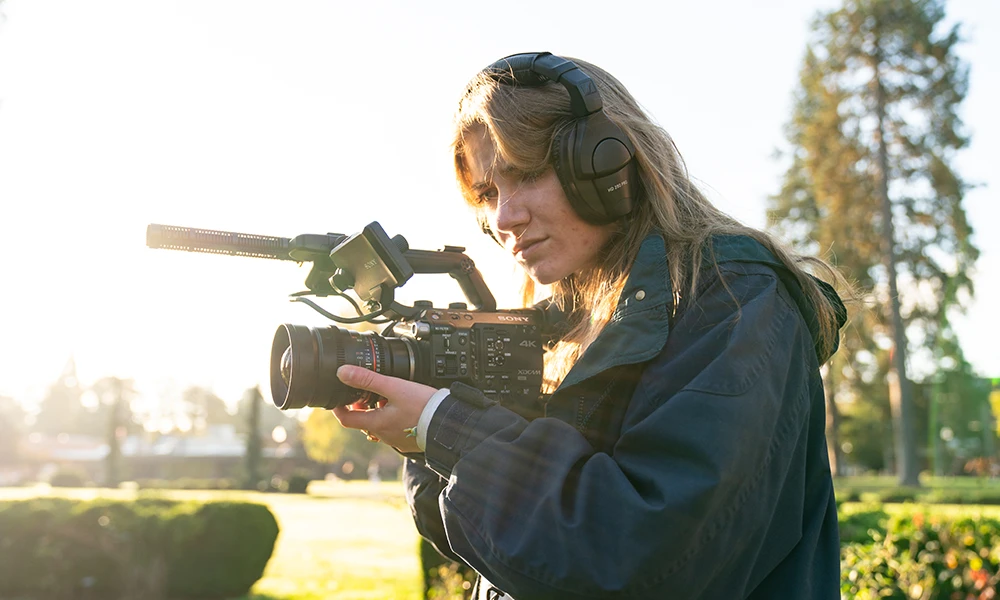
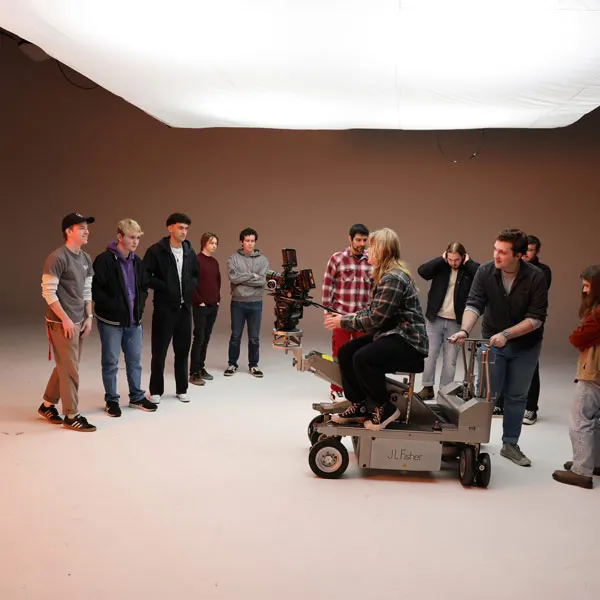
You get hands-on experience with industry-standard equipment. This means your film, audio, and animation goes from good to great. And that means that your vision for your project is fulfilled!
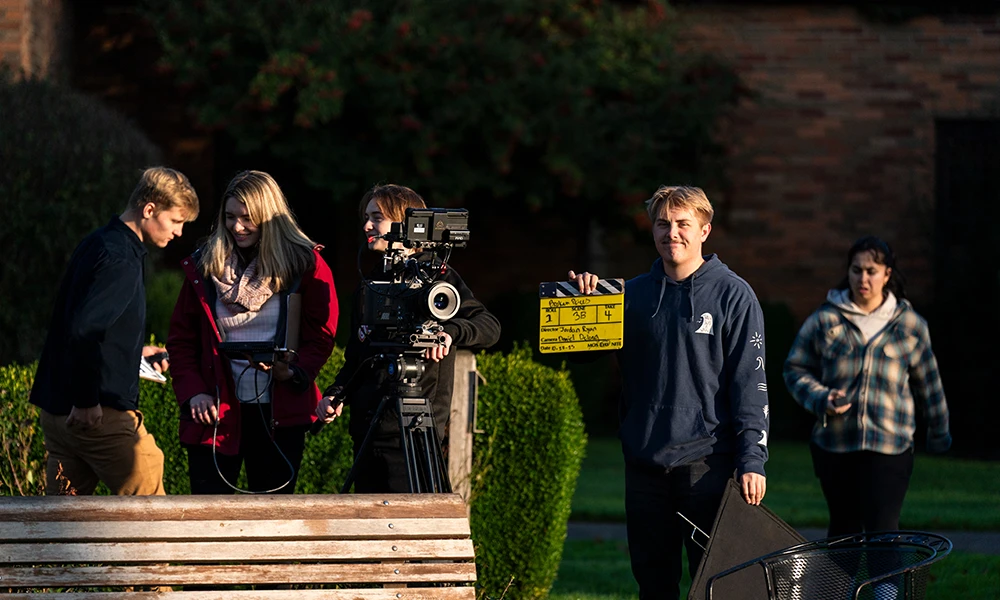
Our students put knowledge into use through a series of intensive, hands-on projects. All our students complete at least one internship to help them channel their passion into a career.
Courses / Curriculum What Will I Study?
You get to pick a focus, while also taking classes that round out your understanding of the many different aspects of the cinematic arts.
Our curriculum covers the broad spectrum of the cinematic arts industry:
Cinematic camera movement and filming techniques (16 mm film technique as well as digital filming)
Lighting for the studio and on location
Sound recording for music and voice
Creating film sound effects and foley
Editing for television and feature film
Filming, writing and editing documentary nonfiction stories for news or streaming as full-length features
Writing an original script for a television series, short or feature film
Directing actors and creating the look of a film
Designing projects with virtual reality, augmented reality or emerging technology
Animation: Storyboarding, concept design, stop-motion animation, 2D & 3D animation and visual effects
The Cornerstone Core is a set of 12 courses across 10 academic disciplines that undergraduate students take at George Fox to cultivate their character within the Christian context.
An historical examination of the moving image, including television programming and film in the United States. Employs contextual and ethical methods for illuminating the relationship of these media artifacts to modern culture, both secular and religious.
Film is a truly an international medium, stretching across borders, decades, and cultures. Students will study international films in terms of the historical, cultural, political, and economic forces that shaped them.
An introduction to film as a narrative and visual medium, emphasizing the terms, methods and techniques of film analysis, as well as prominent critical theoretical approaches to understanding film.
Students work collaboratively to explore story and script essentials, the technical, creative, and aesthetic elements of the video production process. Course includes professional script formatting, basic lighting, sound, camera operation, composition, and design of visual elements, producing and directing basics through lecture, classroom and supervised laboratory experiences.
Professional techniques and artistry of writing for the screen. Students create story premises, write scripts for short films, original and spec television series, and feature films. This course examines plot structure, characterization, dialogue, action, genre, and the business aspects, including agents, script sales, and the Hollywood system. Prerequisite: CINE 230 Cinematic Foundations. Additional course fee is required.
Students explore different means of producing visual effects using digital computer imaging, blue-screens, compositing, and old-fashioned movie magic. Students will also learn how to create animated text sequences and video graphics. Additional course fee required.
An internship experience designed to give students an opportunity to practice video and film techniques and principles in an off-campus, professional setting. Students choose from a variety of options - cable, broadcast, corporate, medical, or commercial production facilities - based on the student's goals and interests. Up to 6 hours may apply to the cinematic arts major. Pass/No Pass. Prerequisite: instructor's permission.
This class helps prepare students for entry into the professional realm by developing networking and marketing strategies, and by preparing a professional reel of their best work, which will be critiqued by members of the local media industry. Prerequisite: senior status. Additional course fee required.
Students in the animation concentration study techniques for producing 2D, 3D and stop motion animation and visual effects using a combination of creativity, aesthetics, and computer software.
A course offering an introduction to industry-standard design software and applications, including Adobe Illustrator, Photoshop, InDesign, SketchUp, and other applications tailored to the instructor's expertise. Students can access the Creative Suite on campus computers in Lemmons. Students not accessing on-campus computers should anticipate purchasing the Creative Suite for a personal device. Additional course fee is required.
A course offering students an expansive understanding of drawing as both an artistic act and a part of the daily creative process. Through skill-building exercises, sketchbook work, concept-driven projects, and critique sessions, students explore the history, techniques, and impact of mark-making. Students develop foundational skills of observational drawing, as well as being introduced to drawing practice's other facets. Additional course fee is required.
This is the study of pre-production and previsualization techniques used in animation. Topics include developing story, storyboarding, concept design, and editing animatics. Prerequisites: ARTD 110 Digital Tools and ARTS 111 Drawing I or instructor's permission. Additional course fee required.
This is an introduction to the fundamentals of animation production, from traditional hand drawn techniques to stop motion animation. In this hands-on workshop, students will produce short animation projects. Additional course fee required.
This is an introduction to 2D computer animation using industry-standard software and techniques. Students will create character animations and short animation projects. Prerequisites: ARTD 110 Digital Tools and CINE 212 Introduction to Animation or instructor's permission. Additional course fee required.
This is an introduction to 3D computer animation using industry-standard software and techniques. Emphasis is placed on modeling, texturing, lighting, and rendering. Students will create original 3D artwork. Prerequisite: ARTD 110 Digital Tools. Additional course fee is required.
Explore the timeless art of stop motion animation in this hands-on course, located just miles from Portland, Oregon—renowned as the stop motion capital of the world. Students will learn the fundamentals of frame-by-frame animation, from character design to set construction and lighting, while honing their skills in storytelling through motion. Through practical projects, participants will bring inanimate objects to life, discovering the intricacies and creative potential of this unique animation form. Additional course fee is required.
In this intensive hands-on production course, students will draw on all their filmmaking skills to produce 10- to 30-minute shorts - narrative, documentary, or animated - for their portfolios and film festivals. This semester focuses on preproduction and production, including script breakdown, casting, and actual filming. Prerequisite: one of the following: CINE 310 Intermediate Directing, CINE 320 Dramatic Scriptwriting, CINE 333 Camera & Lighting, CINE 350 Post-Production Techniques, CINE 430 Producing & Directing Video, or instructor's permission. Admission to the class is a competitive process based on the student's proposal and script. Additional course fee is required.
This course explores the various camera and lighting techniques used in film and digital video production. Students will focus on applying lighting techniques and camera movement to create specific visual effects. Students will apply the ideas discussed in the text and lectures to a series of in-class explorations, in addition to scenes filmed outside of class. Prerequisite: CINE 230 Cinematic Foundations or instructor's permission. Additional course fee required.
An internship experience designed to give students an opportunity to practice video and film techniques and principles in an off-campus, professional setting. Students choose from a variety of options - cable, broadcast, corporate, medical, or commercial production facilities - based on the student's goals and interests. Up to 6 hours may apply to the cinematic arts major. Pass/No Pass. Prerequisite: instructor's permission.
This course continues the project started in Advanced Production Workshop I into postproduction, including editing, sound design, color correction, and DVD authoring. Additional course fee is required. Prerequisite: CINE 481 Advanced Production Workshop I or instructor's permission.
An advanced seminar offered on an occasional basis addressing a current topic in the field that is of special interest to students and current faculty. Prerequisite: Instructor’s permission. Additional course fee may be required.
Working with classmates as crew, students take turns directing scenes from Hollywood movies in this hands-on directing workshop. Beyond storyboarding and shot planning, this class focuses on working with actors, working with crew, and other skills required for balancing the technical and the artistic aspects of directing. Prerequisites: CINE 230 Cinematic Foundations and CINE 333 Camera and Lighting; or instructor's permission.
This course explores the various camera and lighting techniques used in film and digital video production. Students will focus on applying lighting techniques and camera movement to create specific visual effects. Students will apply the ideas discussed in the text and lectures to a series of in-class explorations, in addition to scenes filmed outside of class. Prerequisite: CINE 230 Cinematic Foundations or instructor's permission. Additional course fee required.
This project-based course delves into the core elements of post-production, combining picture editing, sound design, and color grading. Students will learn to shape and refine visual narratives, enhance storytelling through creative soundscapes, and apply color techniques to bring cinematic visions to life. Through hands-on projects, participants will develop technical skills and artistic strategies for crafting polished, cohesive films. Prerequisite: CINE 230 Cinematic Foundations or instructor’s permission. Additional course fee is required.
In this intensive hands-on production course, students will draw on all their filmmaking skills to produce 10- to 30-minute shorts - narrative, documentary, or animated - for their portfolios and film festivals. This semester focuses on preproduction and production, including script breakdown, casting, and actual filming. Prerequisite: one of the following: CINE 310 Intermediate Directing, CINE 320 Dramatic Scriptwriting, CINE 333 Camera & Lighting, CINE 350 Post-Production Techniques, CINE 430 Producing & Directing Video, or instructor's permission. Admission to the class is a competitive process based on the student's proposal and script. Additional course fee is required.
This is the study of pre-production and previsualization techniques used in animation. Topics include developing story, storyboarding, concept design, and editing animatics. Prerequisites: ARTD 110 Digital Tools and ARTS 111 Drawing I or instructor's permission. Additional course fee required.
This is an introduction to the fundamentals of animation production, from traditional hand drawn techniques to stop motion animation. In this hands-on workshop, students will produce short animation projects. Additional course fee required.
This is an introduction to 2D computer animation using industry-standard software and techniques. Students will create character animations and short animation projects. Prerequisites: ARTD 110 Digital Tools and CINE 212 Introduction to Animation or instructor's permission. Additional course fee required.
Working with classmates as crew, students take turns directing scenes from Hollywood movies in this hands-on directing workshop. Beyond storyboarding and shot planning, this class focuses on working with actors, working with crew, and other skills required for balancing the technical and the artistic aspects of directing. Prerequisites: CINE 230 Cinematic Foundations and CINE 333 Camera and Lighting; or instructor's permission.
This is an introduction to 3D computer animation using industry-standard software and techniques. Emphasis is placed on modeling, texturing, lighting, and rendering. Students will create original 3D artwork. Prerequisite: ARTD 110 Digital Tools. Additional course fee is required.
The documentary filmmaker must juggle a multitude of skills while maintaining a relationship with their subject in an ethical manner. Students will explore the historical, critical, and ethical aspects of the documentary while studying the steps taken during preproduction. Prerequisite: CINE 230 Cinematic Foundations. Additional course fee is required.
This course continues the documentary experience started in Documentary Production I. Students will apply their understanding of documentary filmmaking while exploring the aspects of production and post-production. Additional course fee is required. Prerequisite: CINE 371 Documentary Production I.
This is an advanced course in 3D computer animation using industry standard software and techniques. Emphasis is placed on rigging and character animation. Students will create short animation projects. Additional course fee required.
Prerequisite: CINE 212 Introduction to Animation and CINE 312 3D Computer Animation I
An advanced course in video directing and producing. Students explore the preproduction, production, and postproduction of original short feature videos for the Fox Film Festival. Prerequisite: CINE 350 Post-Production Techniques. Additional course fee required.
An advanced seminar offered on an occasional basis addressing a current topic in the field that is of special interest to students and current faculty. Prerequisite: Instructor’s permission. Additional course fee may be required.
Students will learn basic techniques of songwriting, including lyrics and song structure. Students will write their own songs, which they will then produce and record. Prerequisite: CINE 243 Introduction to Audio or MUSI 180 Introduction to Music Technology or THEA 130 Stagecraft or by instructor’s permission.
OR
Up to 15 semester hours of course work at the Los Angeles Film Studies Center.
A course offering an introduction to industry-standard design software and applications, including Adobe Illustrator, Photoshop, InDesign, SketchUp, and other applications tailored to the instructor's expertise. Students can access the Creative Suite on campus computers in Lemmons. Students not accessing on-campus computers should anticipate purchasing the Creative Suite for a personal device. Additional course fee is required.
A course offering students an expansive understanding of drawing as both an artistic act and a part of the daily creative process. Through skill-building exercises, sketchbook work, concept-driven projects, and critique sessions, students explore the history, techniques, and impact of mark-making. Students develop foundational skills of observational drawing, as well as being introduced to drawing practice's other facets. Additional course fee is required.
This is an introduction to the fundamentals of animation production, from traditional hand drawn techniques to stop motion animation. In this hands-on workshop, students will produce short animation projects. Additional course fee required.
This is an introduction to 2D computer animation using industry-standard software and techniques. Students will create character animations and short animation projects. Prerequisites: ARTD 110 Digital Tools and CINE 212 Introduction to Animation or instructor's permission. Additional course fee required.
This is an introduction to 3D computer animation using industry-standard software and techniques. Emphasis is placed on modeling, texturing, lighting, and rendering. Students will create original 3D artwork. Prerequisite: ARTD 110 Digital Tools. Additional course fee is required.
In this intensive hands-on production course, students will produce 3 fully functional prototype video games in 3D and 2D mediums. This semester focuses on the artistic side of game production, including concept work, art, and animation. Through this course, students will also experience production workflows using an array of industry-standard software to accomplish these project goals. Students will create their own games over the semester. Prerequisites: ARTD 110 Digital Tools, CINE 212 Introduction to Animation, or instructor's permission. Additional course fee is required.
A course for learning the essentials of programming for video games using an industry-standard video game engine. This course will cover the requisite high-level programming languages, object-oriented programming, event-driven programming, as well as fundamental features and concepts in game development. The course will be centered on project-based learning, and students will create their own games over the semester. Prerequisites: ARTD 110 Digital Tools and CSIS 202 Introduction to Computer Science II, or instructor's permission.
A foundational course for the study of computer science and information systems. The course covers an overview of programming methodology and gives the student an ability to write computer programs using standard style and structure. Programming projects are completed in one or more high-level languages. Additional course fee is required. Prerequisite: High school algebra or equivalent.
A foundational course for the study of computer science and information systems. The course covers an overview of programming methodology and gives the student an ability to write computer programs using standard style and structure. Programming projects are completed in one or more high-level languages. Additional course fee is required. Prerequisite: CSIS 201 Introduction to Computer Science I or ENGR 152 Engineering Principles II.
A course offering an introduction to typography including type history, typefaces, type selection and layout, the use of type in effective designs, and creative approaches to using type. Prerequisite: ARTD 110 Digital Tools. Additional course fee is required.
A course focusing on the design of interactive objects and experiences, with a focus on user interface (UI) and user experience (UX) design. Key topics include navigation, information architecture, kinetic design, and the development of intuitive and effective interfaces. Students also explore research methods central to UI/UX design, gaining the skills necessary to craft seamless and engaging digital experiences. Prerequisite: ARTD 210 Typography. Additional course fee is required.
This is the study of pre-production and previsualization techniques used in animation. Topics include developing story, storyboarding, concept design, and editing animatics. Prerequisites: ARTD 110 Digital Tools and ARTS 111 Drawing I or instructor's permission. Additional course fee required.
An advanced seminar offered on an occasional basis addressing a current topic in the field that is of special interest to students and current faculty. Prerequisite: Instructor’s permission. Additional course fee may be required.
An introduction to the concepts of information organization and manipulation. The course covers basic sequential structures such as array-backed lists, singly- and doubly-linked lists, stacks, and queues, and moves on to more complex data structures such as trees, graphs, priority queues, and dictionaries. Programming projects are completed in one or more high-level languages. Prerequisite: CSIS 202 Introduction to Computer Science II. Additional course fee is required.
An introduction to the formal processes and industry-standard tools used in producing quality software. The entire life cycle of software development is presented and utilized. Students work in teams to specify, design, implement, test, release, and maintain a non-trivial software project using a modern software development methodology. Additional course fee required. Prerequisite: CSIS 202 Introduction to Computer Science II.
An introduction to the principles and methods used to design effective interfaces for users. A basic precept of human-computer interactions (HCI) is that users should be enabled to focus on achieving their goals, rather than forced to deal with the intricacies of complex software and features. The course provides an overview of human perception and cognition with respect to hardware and software interfaces and emphasizes a human-centered design approach to crafting goal-oriented interfaces based on detailed personae development, comprehensive user stories, storyboarding, design sketches, and low- and high-fidelity functional prototypes. Students will apply principles learned in the course to design, construct, and evaluate various types of interfaces. The course provides a balance of theoretical and applied knowledge in an oft-neglected aspect of software development, giving students experience not typically provided by other courses in computer science. Prerequisite: CSIS 201 Introduction to Computer Science I. Additional course fee is required.
A study of the fundamental concepts of object-oriented programming, including data abstraction and typing, encapsulation, single and multiple inheritance, substitutability, static and dynamic polymorphism, generics, interfaces, and design patterns. Object-oriented solutions will be designed using UML class and sequence diagrams and implemented in one or more high-level languages. Additional course fee is required. Prerequisite: CSIS 310 Data Structures.
An introduction to the design and analysis of algorithms. The course covers the fundamentals of analyzing algorithms for correctness and time and space bounds. Topics include advanced sorting and searching methods, graph algorithms, geometric algorithms, matrix manipulations, string and pattern matching, set algorithms, and polynomial computations. Additional course fee is required. Prerequisite: CSIS 310 Data Structures.
An introduction to the basic concepts and techniques of artificial intelligence (AI), knowledge representation, reasoning and problem solving, AI search techniques, and moral and ethical considerations related to the use of AI-based systems. AI solutions will be developed in an appropriate AI language. Additional course fee is required. Prerequisite: CSIS 310 Data Structures. (CSIS 430 Analysis of Algorithms preferred.)
Students work collaboratively to explore story and script essentials, the technical, creative, and aesthetic elements of the video production process. Course includes professional script formatting, basic lighting, sound, camera operation, composition, and design of visual elements, producing and directing basics through lecture, classroom and supervised laboratory experiences.
An historical examination of the moving image, including television programming and film in the United States. Employs contextual and ethical methods for illuminating the relationship of these media artifacts to modern culture, both secular and religious.
Survey of the historical development of newspapers, magazines, broadcast media, and cinema. Analysis of the role(s) of mass media in shaping and altering opinion and values in contemporary culture.
Note: A limit of 3 hours of each of the following may apply to the elective requirement: CINE 285/485 Selected Topics, CINE 475 Field Experience and/or CINE 295/495 Individualized Study.
Survey of the historical development of newspapers, magazines, broadcast media, and cinema. Analysis of the role(s) of mass media in shaping and altering opinion and values in contemporary culture.
A course designed to introduce and develop a clear concept of public relations as a communication profession. Topics to be covered include the function of public relations in both public and private enterprises; the process of planning and implementing a public relations communication campaign; techniques for communicating with various publics; and the laws and ethics governing the practice of public relations.
Methods of rhetorical criticism as applied to public communication of the past and present, including but not limited to speeches, broadcasts, films, and campaigns. Analysis of current trends in rhetorical criticism. Prerequisite: junior standing or above.
This course explores trends in media convergence, focusing as well on the ways reporters, editors, and designers create stories for the web. Particular emphasis will be on web-based story design, the coordination of text and art, and the creation of stories for a variety of new media outlets. Prerequisite: WRIT 111 Caring for Words, enrollment in the Honors Program, or instructor permission.
Note: A limit of 3 hours of each of the following may apply to the elective requirement: CINE 285/485 Selected Topics, CINE 475 Field Experience and/or CINE 295/495 Individualized Study.
Our spaces/Where Will I Learn?
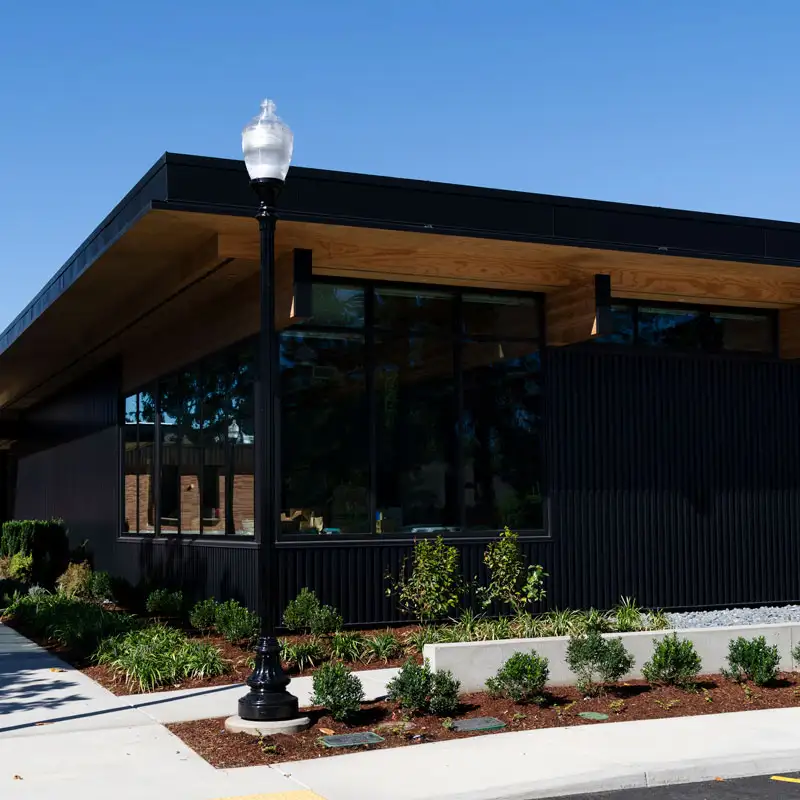
Art & Cinematic Arts Building
Create and collaborate in open studio spaces designed for studio arts, illustration and cinematic arts students. Art students work in a large ceramics and pottery studio, dedicated glass and sculpture spaces, and a partially covered courtyard with a kiln for hands-on making.
Cinematic arts students can edit video, record audio, film in a studio space, and share their work in a dedicated screening theater.
Located between the Maker Hub and Pennington Residence Hall, this 12,000-square-foot facility gives you the space to create and gain industry experience.
Employment of broadcast, sound, and video technicians is projected to grow 1% from 2025 to 2035, according to the U.S. Bureau of Labor Statistics. There are numerous opportunities in film, radio, music and other audio productions including, books, podcasts and radio.
Our cinematic arts students have gone on to do some game-changing work in the professional world.
Below are some of the common career paths our cinematic arts graduates pursue or are well-equipped to go on to. Keep in mind that while a bachelor's degree provides a strong foundation, certain specialized or advanced roles may require additional education or experience.
Art Directors
$106,500
Special Effects Artists and Animators
$99,060
Producers and Directors
$82,510
Writers and Authors
$73,690
Film and Video Editors
$66,600
Television, Video, and Film Camera Operators and Editors
$65,070
Camera Operators, Television, Video, and Film
$61,800
Broadcast, Sound, and Lighting Technicians
$54,160
U.S. Bureau of Labor Statistics (2026)
Practical Experience for a Creative Career
"Film felt like the thing I loved, but not necessarily the thing I could build a career on... but somewhere along the way, you stop saying 'I think I like film' and you start saying 'I'm a filmmaker.'" - Maia Kill, Cinematic Arts Graduate
When Maia Kill visited George Fox during the annual Scholarship Summit, she discovered a cinematic arts program that transformed her career path. From her first semester, she gained hands-on experience creating films, collaborating with peers, and developing industry-ready skills.
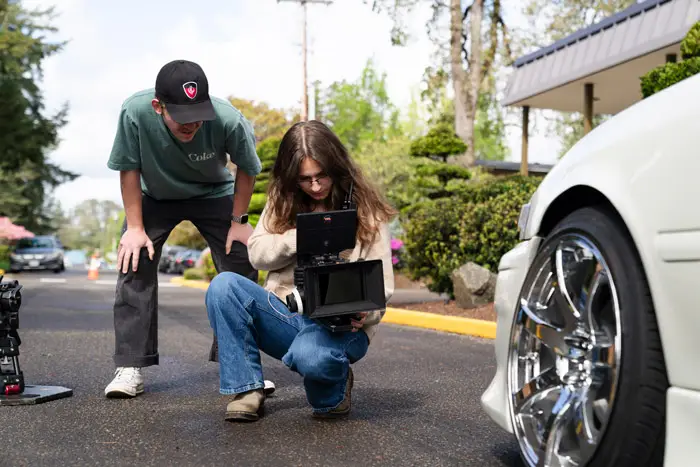
Her experience culminated in serving as producer for a promotional video featuring professional drift-car stunts for the annual Fox Film Festival — an opportunity that provided real-world leadership and production experience before graduation.
My time as a cinematic arts major at George Fox was a truly enriching experience. My professors were extremely knowledgeable, encouraging, and made me feel prepared to work in the industry. The program is full of passion that intertwines with a desire to bring honor to God through our creation of art. We were encouraged to use the creativity that we were blessed with and share it with those around us.









 Loading...